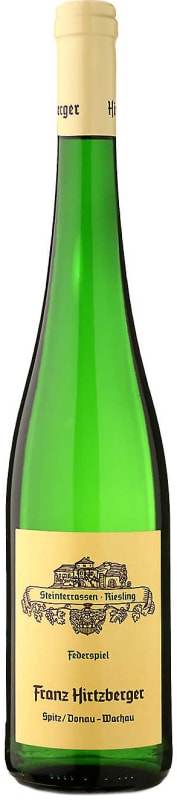


Winemaker Notes
The Franz Hirtzberger Federspiel Steinterrassen Riesling presents a lively bouquet of ripe peaches and apricots, complemented by delicate floral notes. On the palate, it offers a harmonious balance between zesty citrus acidity and mineral undertones, leading to a crisp, refined finish. This Riesling showcases the vibrant character and complexity typical of the Wachau region.
Professional Ratings
-
James Suckling
I love the fresh aromas in this bright, medium-bodied white. Notes of grapefruit, green apples, jasmine and juniper berries flow through to a silky, fresh and very approachable palate. Drink now or hold.
-
Vinous
The 2024 Riesling Steinterrassen Federspiel is the first harvest pass of the Singerriedel, Hochrain, Steinporz and Setzberg sites. Flinty crackle enlivens the nose, where tangerine and lemony drive are fringed by a lovely touch of ivy. The palate is juicy, stony, vivid and straight. This is a lighter wine than usual but full of verve and joy.


Riesling possesses a remarkable ability to reflect the character of wherever it is grown while still maintaining its identity. A regal variety of incredible purity and precision, this versatile grape can be just as enjoyable dry or sweet, young or old, still or sparkling and can age longer than nearly any other white variety. Somm Secret—Given how difficult it is to discern the level of sweetness in a Riesling from the label, here are some clues to find the dry ones. First, look for the world “trocken.” (“Halbtrocken” or “feinherb” mean off-dry.) Also a higher abv usually indicates a drier Riesling.

As Austria’s most prestigious wine growing region, the landscape of the Wachau is—not surprisingly—one of its most dramatic. Millions of years ago, the Danube River chiseled its way through the earth, creating steep terraces of decomposed volcanic and metamorphic rock. Harsh Ice Age winds brought deposits of ancient glacial dust and loess to the terrace’s eastern faces. Today these steep surfaces of nutrient-poor and fast draining soil are home to some of Austria’s very best sites for both Grüner Veltliner and Riesling.
Wachau is small, comprising a mere three percent of Austria’s vine surface and, considering relatively low yields, represents a miniscule proportion of total wine production. Diurnal temperature shifts in Wachau facilitate great balance of sugar and phenolic ripeness in its grapes. At night cold air from the Alps and forests in the northwest displace warm afternoon air, which gets sucked upstream along the Danube.
Its sites are actually so varied and distinct that more emphasis is going into vineyard-designated offerings even despite grape variety. Grüner Veltliner and Riesling are most prominent, but the region produces Chardonnay, Pinot Blanc (Weissburgunder), Pinot Gris, Sauvignon Blanc and Zweigelt among other local variants.