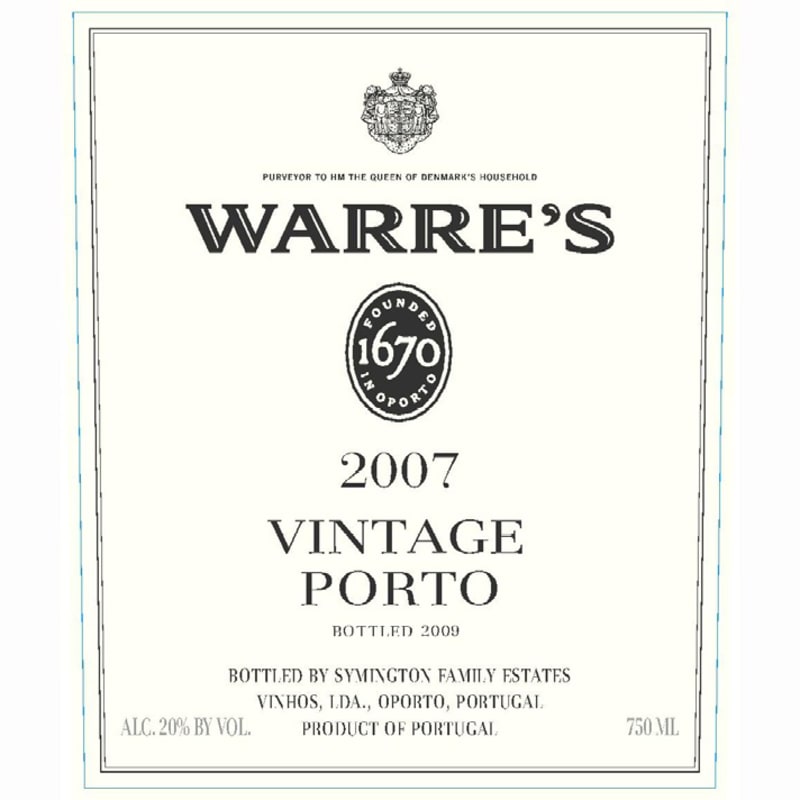

Winemaker Notes
Professional Ratings
-
Wine Spectator
Offers lovely perfumed aromas and beautiful raspberry and blackberry character, turning to tar, black truffle and wet earth. Full-bodied and medium sweet, with a balance of very chewy tannins and sugary fruit at the finish. This goes on and on. The great 1994 again?
-
Wine & Spirits
This massive, glass-coating wine has a purple edge deepening to the center, where it glows black. But rather than feeling massive, it's elegant, the way that the roar of a Moto Guzzi is elegant. It's mellow and relaxed as the flavors plow on for minutes in a crush of black satin. You might find green peppercorn, scents of edamame or savory and sweet tobacco in its wake. As fascinating and delicious as this wine may be to spar with today, it will likely be best 20 to 30 years from now.
-
Robert Parker's Wine Advocate
The 2007 Warre Vintage Port is one of the stars of the vintage. A glass-coating opaque purple color, it displays an expressive bouquet of Asian spices, incense, lavender, blackberry, and fruitcake. Plush on the palate with outstanding volume, it exhibits a sense of elegance as well as power. Savory flavors, plenty of structure for the long haul, and a lengthy, fruit-filled finish suggests two decades of cellaring are in order. This superb effort should still be drinking well in 2050.


Port is a sweet, fortified wine with numerous styles: Ruby, Tawny, Vintage, Late Bottled Vintage (LBV), White, Colheita, and a few unusual others. It is blended from from the most important red grapes of the Douro Valley, based primarily on Touriga Nacional with over 80 other varieties approved for use. Most Ports are best served slightly chilled at around 55-65°F. To learn more, see our full Port Wine Guide

The home of Port—perhaps the most internationally acclaimed beverage—the Douro region of Portugal is one of the world’s oldest delimited wine regions, established in 1756. The vineyards of the Douro, set on the slopes surrounding the Douro River (known as the Duero in Spain), are incredibly steep, necessitating the use of terracing and thus, manual vineyard management as well as harvesting. The Douro's best sites, rare outcroppings of Cambrian schist, are reserved for vineyards that yield high quality Port.
While more than 100 indigenous varieties are approved for wine production in the Douro, there are five primary grapes that make up most Port and the region's excellent, though less known, red table wines. Touriga Nacional is the finest of these, prized for its deep color, tannins and floral aromatics. Tinta Roriz (Spain's Tempranillo) adds bright acidity and red fruit flavors. Touriga Franca shows great persistence of fruit and Tinta Barroca helps round out the blend with its supple texture. Tinta Cão, a fine but low-yielding variety, is now rarely planted but still highly valued for its ability to produce excellent, complex wines.
White wines, generally crisp, mineral-driven blends of Arinto, Viosinho, Gouveio, Malvasia Fina and an assortment of other rare but local varieties, are produced in small quantities but worth noting.
With hot summers and cool, wet winters, the Duoro has a maritime climate.