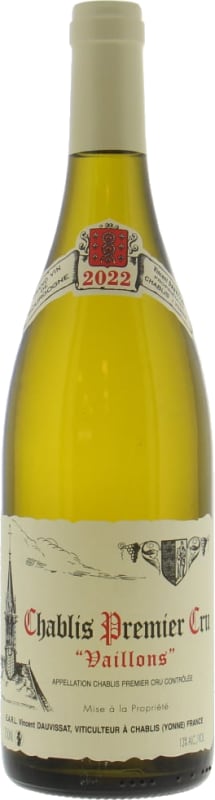


Winemaker Notes
Professional Ratings
-
Jasper Morris
Pale lemon yellow. This is very classy, purer and fresher, with all the little stones queuing up at the end of the palate, savoury but with fresh white fruit all around, much less dry than Séchet. Fine long finish. Barrel Sample: 91-94
-
Robert Parker's Wine Advocate
Bursting with notes of white flowers, orange zest, nutmeg and iodine, the 2022 Chablis 1er Cru Vaillons is medium to full-bodied, ample and fleshy, with bright acids and a long, expansive and perfumed finish. As ever, its expressive, charming style makes it something of the more-mineral Séchet's alter ego.
Barrel Sample: 92-94 -
Vinous
The 2022 Chablis Vaillons 1er Cru has a rather strict nose, backward with crushed stone and fleeting white flowers. The palate has a lovely rondeur on the entry with white peach and nectarine, those deep clayey soils giving depth and persistence to the finish. Quite powerful, but it will need time.
Barrel Sample: 92-94 -
James Suckling
A mere 200 meters from the meager soils of Sechet, this is a site with more clay. A more voluminous expression, rounder and mouth-filling, with a note of phenolics as much as freshness. Tangerines with hints of stone fruit and nuts. An easy wine to love, without quite the pixelated freshness and exquisite detail of the Sechets.


One of the most popular and versatile white wine grapes, Chardonnay offers a wide range of flavors and styles depending on where it is grown and how it is made. While it tends to flourish in most environments, Chardonnay from its Burgundian homeland produces some of the most remarkable and longest lived examples. California produces both oaky, buttery styles and leaner, European-inspired wines. Somm Secret—The Burgundian subregion of Chablis, while typically using older oak barrels, produces a bright style similar to the unoaked style. Anyone who doesn't like oaky Chardonnay would likely enjoy Chablis.

The source of the most racy, light and tactile, yet uniquely complex Chardonnay, Chablis, while considered part of Burgundy, actually reaches far past the most northern stretch of the Côte d’Or proper. Its vineyards cover hillsides surrounding the small village of Chablis about 100 miles north of Dijon, making it actually closer to Champagne than to Burgundy. Champagne and Chablis have a unique soil type in common called Kimmeridgian, which isn’t found anywhere else in the world except southern England. A 180 million year-old geologic formation of decomposed clay and limestone, containing tiny fossilized oyster shells, spans from the Dorset village of Kimmeridge in southern England all the way down through Champagne, and to the soils of Chablis. This soil type produces wines full of structure, austerity, minerality, salinity and finesse.
Chablis Grands Crus vineyards are all located at ideal elevations and exposition on the acclaimed Kimmeridgian soil, an ancient clay-limestone soil that lends intensity and finesse to its wines. The vineyards outside of Grands Crus are Premiers Crus, and outlying from those is Petit Chablis. Chablis Grand Cru, as well as most Premier Cru Chablis, can age for many years.