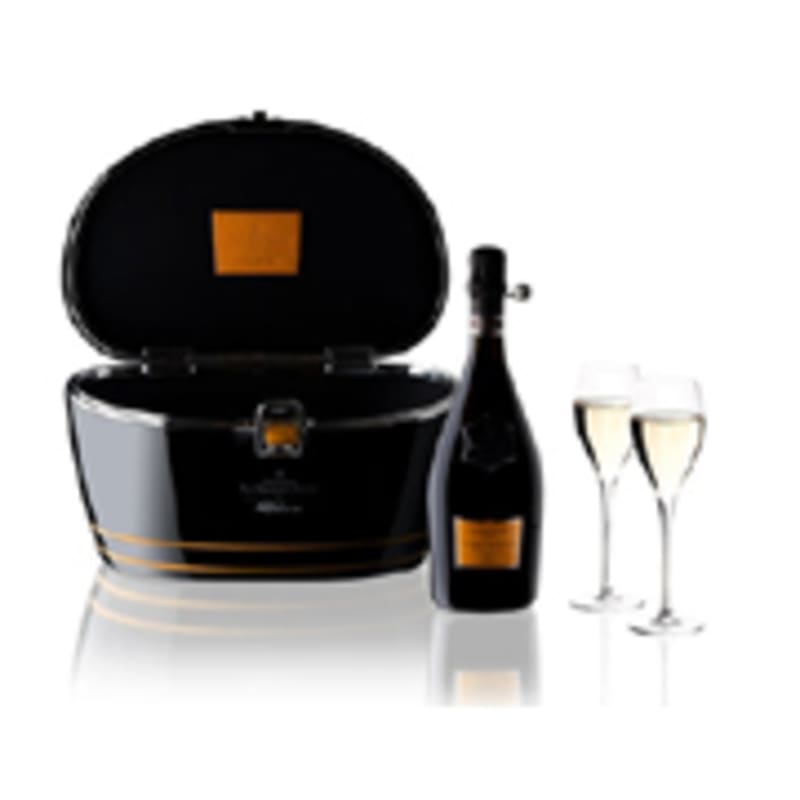

Winemaker Notes
The limited edition Cruiser Bag contains one Special Edition La Grande Dame 1998 Riva label bottle and two glasses protected by an isothermal case. With its sleek design of mahogany edged in chrome, this 24-hour case brings true style and glamour on-the-go.
La Grande Dame is Veuve Clicquot's prestige cuvee, named after its legendary founder Madame Clicquot.
La Grande Dame 1998 has a pale gold color with jade glints. The wine is crystal clear, with unbelievably fine bubbles.
On the first nose, typical Chardonnay characteristics come to the fore, with the arrival of floral and mineral aromas (acacia, ferns, chalk). By agitating the wine, scents of candied fruit (citrus fruits, apricots, quince) and sweet almond emerge, to reappear later in the mouth. After rotating the wine for a few minutes more, rare notes such as peaty malt, tobacco and delicate herbs, are gradually unveiled.
This aromatic, impressively complex bouquet is confirmed in the mouth. On the palate, the wine is clear-cut and pure, perfectly balanced with a delightful silky smoothness. La Grande Dame 1998, with its lace-like construction, has a long, lively, and structured finish.
This wine has unbelievable aging potential. The 1998 vintage of La Grande Dame, the quintessence of the Veuve Clicquot style, reaches a peak of refinement, without losing its legendary strength produced by a blend including nearly two-thirds of Pinot Noir.
"The contrast of depth and brightness, or intensity and weightlessness creates a sense of harmonic resonance in this wine. All the aromatics are potent, from the scent of rising bread dough to the red skin of an apple, all the corresponding flavors rich yet refreshing. The firmness of the acidity seems to add briskness to the mousse, leaving a clean, chiseled impression of the chalk soils in which this grew. Once in a while, there is a young beauty who will age into a more profound older beauty; La Grande Dame is part of that rare breed."
-Wines & Spirits
Professional Ratings


Representing the topmost expression of a Champagne house, a vintage Champagne is one made from the produce of a single, superior harvest year. Vintage Champagnes account for a mere 5% of total Champagne production and are produced about three times in a decade. Champagne is typically made as a blend of multiple years in order to preserve the house style; these will have non-vintage, or simply, NV on the label. The term, "vintage," as it applies to all wine, simply means a single harvest year.

Associated with luxury, celebration, and romance, the region, Champagne, is home to the world’s most prized sparkling wine. In order to bear the label, ‘Champagne’, a sparkling wine must originate from this northeastern region of France—called Champagne—and adhere to strict quality standards. Made up of the three towns Reims, Épernay, and Aÿ, it was here that the traditional method of sparkling wine production was both invented and perfected, birthing a winemaking technique as well as a flavor profile that is now emulated worldwide.
Well-drained, limestone and chalky soil defines much of the region, which lend a mineral component to its wines. Champagne’s cold, continental climate promotes ample acidity in its grapes but weather differences from year to year can create significant variation between vintages. While vintage Champagnes are produced in exceptional years, non-vintage cuvées are produced annually from a blend of several years in order to produce Champagnes that maintain a consistent house style.
With nearly negligible exceptions, . These can be blended together or bottled as individual varietal Champagnes, depending on the final style of wine desired. Chardonnay, the only white variety, contributes freshness, elegance, lively acidity and notes of citrus, orchard fruit and white flowers. Pinot Noir and its relative Pinot Meunier, provide the backbone to many blends, adding structure, body and supple red fruit flavors. Wines with a large proportion of Pinot Meunier will be ready to drink earlier, while Pinot Noir contributes to longevity. Whether it is white or rosé, most Champagne is made from a blend of red and white grapes—and uniquely, rosé is often produce by blending together red and white wine. A Champagne made exclusively from Chardonnay will be labeled as ‘blanc de blancs,’ while ones comprised of only red grapes are called ‘blanc de noirs.’