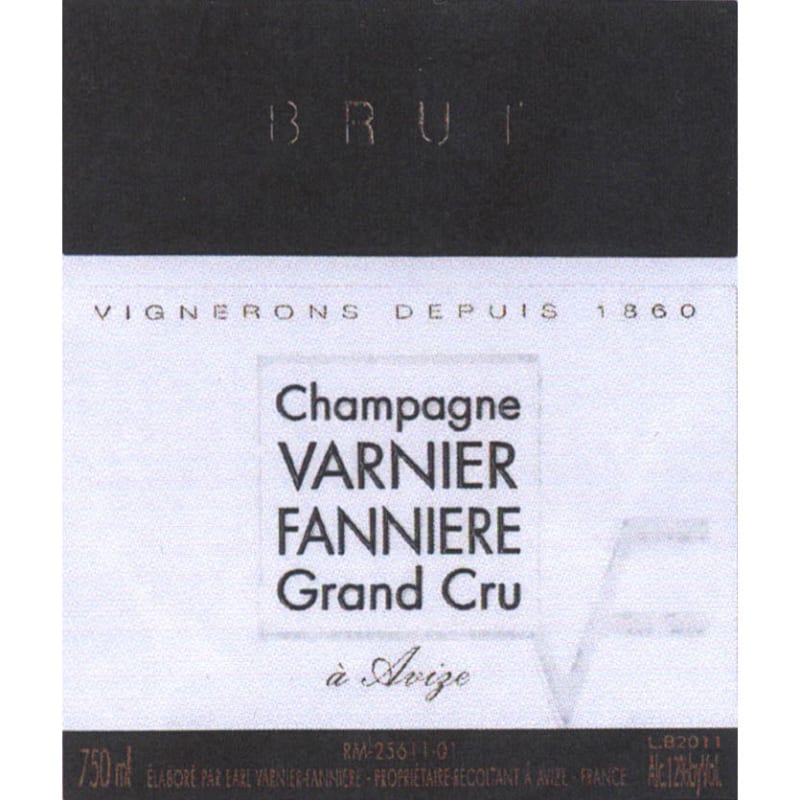

Winemaker Notes
Its color is fresh, a pale yellow with hints of jade. The nose brings out aromas of lemon mixed with hints of ripe fruits, apricots and green apples. On the palate the first mouthful is fresh and lively, the finesse of chardonnay gives it an extra dimension, finishing with a touch of minerality.
Professional Ratings
-
Wine & Spirits
This wine is based on the 2017 harvest, the first season Valérie Varnier was working on her own, having taken charge at the estate after her husband, Denis, passed away. It’s a pretty righteous wine: A pure chalk beauty with impeccable precision, it has the floral scent of freshly churned butter and the earthiness of a fresh-dug potato combining in rich elegance, a luscious wine without weight. To Mariko Kobayashi, it showed off “great growing, getting everything right in the vineyard.”
-
Robert Parker's Wine Advocate
Disgorged in September 2019 with 10 grams per liter dosage, the new release of Varnier-Fannière's NV Brut Grand Cru opens in the glass with notes of citrus oil, green apple, white flowers and pastry cream that only hints at the complexity to come with more time on cork. On the palate, the wine is medium to full-bodied, pure and nicely defined, with a fleshy core of fruit, a delicate pinpoint mousse and an attractively mineral finish. Rating: 92+
-
Wine Spectator
Offers appealing floral and spice notes that waft through juicy yellow peach and white cherry fruit, pickled ginger and mineral notes carried on a refined mousse. Reveals hints of salted almond and candied orange peel on the finish. Chardonnay.
-
Jeb Dunnuck
The NV Champagne Grand Cru Brut is perfumed and forward with ripe orchard fruit, wild tarragon, quinine, and tangerine. The palate is equally assertive and expansive, with juicy yellow orchard fruit, ripe tangerine, a dense core, and chalky earth. Best After 2022


A term typically reserved for Champagne and Sparkling Wines, non-vintage or simply “NV” on a label indicates a blend of finished wines from different vintages (years of harvest). To make non-vintage Champagne, typically the current year’s harvest (in other words, the current vintage) forms the base of the blend. Finished wines from previous years, called “vins de reserve” are blended in at approximately 10-50% of the total volume in order to achieve the flavor, complexity, body and acidity for the desired house style. A tiny proportion of Champagnes are made from a single vintage.
There are also some very large production still wines that may not claim one particular vintage. This would be at the discretion of the winemaker’s goals for character of the final wine.

Associated with luxury, celebration, and romance, the region, Champagne, is home to the world’s most prized sparkling wine. In order to bear the label, ‘Champagne’, a sparkling wine must originate from this northeastern region of France—called Champagne—and adhere to strict quality standards. Made up of the three towns Reims, Épernay, and Aÿ, it was here that the traditional method of sparkling wine production was both invented and perfected, birthing a winemaking technique as well as a flavor profile that is now emulated worldwide.
Well-drained, limestone and chalky soil defines much of the region, which lend a mineral component to its wines. Champagne’s cold, continental climate promotes ample acidity in its grapes but weather differences from year to year can create significant variation between vintages. While vintage Champagnes are produced in exceptional years, non-vintage cuvées are produced annually from a blend of several years in order to produce Champagnes that maintain a consistent house style.
With nearly negligible exceptions, . These can be blended together or bottled as individual varietal Champagnes, depending on the final style of wine desired. Chardonnay, the only white variety, contributes freshness, elegance, lively acidity and notes of citrus, orchard fruit and white flowers. Pinot Noir and its relative Pinot Meunier, provide the backbone to many blends, adding structure, body and supple red fruit flavors. Wines with a large proportion of Pinot Meunier will be ready to drink earlier, while Pinot Noir contributes to longevity. Whether it is white or rosé, most Champagne is made from a blend of red and white grapes—and uniquely, rosé is often produce by blending together red and white wine. A Champagne made exclusively from Chardonnay will be labeled as ‘blanc de blancs,’ while ones comprised of only red grapes are called ‘blanc de noirs.’