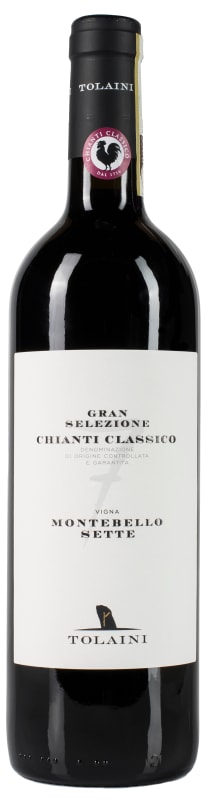


Winemaker Notes
This is a sensual wine with notes of cherry fruit, tobacco, leather and hints of licorice and spice. The elegant tannins balance nicely with the fruit, all underlined by a fabulous stratum of acidity, making this a complex wine with incontestable structure and power. A long and satisfying finish confirms this Sangiovese is true to its terroir.
Professional Ratings
-
Wine Spectator
This is tightly wound, fresh and austere now, its cherry, almond, mineral and tobacco flavors compressed. Hard to see where this is going, yet no one element sticks out, so the potential is fine. Best from 2023 through 2040.
-
James Suckling
A spicy and decadent Chianti Classico that shows plenty of dried cherries, vanilla, mahogany and bark. Full-bodied with integrated but drying tannins, some good acidity and a round, fruit-driven finish. Drink from 2023.
-
Robert Parker's Wine Advocate
The 2015 Chianti Classico Gran Selezione Montebello Sette feels just as important as it sounds. It offers big, mature and dense fruit that you can chew on. This pure Sangiovese carries itself with great fullness, generous fruit and nicely integrated tannins, and it begs for a steak au poivre. You can't overstate the thickness and softness here. Some 15,000 bottles were produced.
-
Wine & Spirits
The Tolaini estate sits in Chianti Classico’s southernmost commune of Castelnuovo Berardenga, where the clayladen soils produced a velvety Gran Selezione in the warm and dry 2015 vintage. The wine, a pure sangiovese, unfolds with flavors of black cherry and dark plum accented by notes of toasted nuts and sweet spice gained during 18 months in French oak barriques. Hints of cherry pit and roasted mushroom lend a savory balance to the rich fruit and oak flavors.






Pierluigi Tolaini, a native of Tuscany, immigrated to Canada in 1956. He planned to work a few years, make some money, then go back home, buy a farm, marry his high school sweetheart and make some good wine... and not with his feet this time! It took Pierluigi 45 years before he returned with a clear vision of the high quality wine he wanted to make: one of Italy's best, no less. In 1998 he returned to his native land and purchased some of the best land in the region of Chianti Classico in the noted commune of Castelnuovo Berardenga. He constructed, from the roots up, this state-of-the-art winery and brought together the best technology and winemakers to bring to light wines that would be a true expression of this significant region. Pierluigi hired famed enologist Michel Rolland and Tuscan agronomist Andrea Paoletti, who put together a team that share Pierluigi's vision - to make the best wines possible with one vitally unique ingredient - the terroir of Chianti Classico's southern most commune: Castelnuovo Berardenga . A true marriage of tradition and modern technology. The belief in the "best fruit produces the best wine" is the fundamental principal of the Tolaini estate. High density planting per hectare and low yield per plant is a proven strategy worldwide in producing excellent quality fruit. With up to 11,500 plants per hectare in the less hilly vineyards, drip irrigation for each plant, and two green harvests to pre-select the healthiest and most promising bunches on the vine, the Tolaini property produces fruit of unsurpassable quality. This fruit is evident in every mouthful of the estate's four incredible red wines.
Ruggero Mazzilli is Tolaini's consulting agronomist and is based in Gaiole in Chianti where he is the owner and founder of SPEVIS (The Experimental Station for Sustainable Viticulture). Under Ruggero's supervision Panzano in Chianti became the first Bio-Distretto (Organic District) in the world, immediately followed by San Gimignano and Gaiole in Chianti. SPEVIS works with the best scientific research institutes to find new solutions to practical vineyard issues by following the principles of organic agriculture and respectful environmental practices. With Ruggero as part of the team, Tolaini will continue to cultivate the maximum expression of Chianti Classico terroir while farming organically and sustainably.
Like the vineyards surrounding it, the winery at Tolaini Estate is an expression of both old and new. An optical sorter guarantees that only the healthy whole grapes make it into the fermentation vats. The best grapes from each harvest are fermented in open-top fermenters made of French Allier oak (12 units of 4500 liter capacity), a time-proven touch that increases the complexity in the wines. The generous array of tank sizes allows for individual parcels of grapes to be fermented and stored separately. These batches are kept apart through subsequent barrel aging in new French oak before blending. Today Luca D'Attoma is the consulting oenologist and his hand is apparent starting with the 2015 vintage of Tolaini.
Tolaini wines are known internationally for their impeccable quality and incredible taste. With each new vintage they continue to innovate and impress.

Among Italy's elite red grape varieties, Sangiovese has the perfect intersection of bright red fruit and savory earthiness and is responsible for the best red wines of Tuscany. While it is best known as the chief component of Chianti, it is also the main grape in Vino Nobile di Montepulciano and reaches the height of its power and intensity in the complex, long-lived Brunello di Montalcino. Somm Secret—Sangiovese doubles under the alias, Nielluccio, on the French island of Corsica where it produces distinctly floral and refreshing reds and rosés.

One of the first wine regions anywhere to be officially recognized and delimited, Chianti Classico is today what was originally defined simply as Chianti. Already identified by the early 18th century as a superior zone, the official name of Chianti was proclaimed upon the area surrounding the townships of Castellina, Radda and Gaiole, just north of Siena, by Cosimo III, Grand Duke of Tuscany in an official decree in 1716.
However, by the 1930s the Italian government had appended this historic zone with additonal land in order to capitalize on the Chianti name. It wasn’t until 1996 that Chianti Classico became autonomous once again when the government granted a separate DOCG (Denominazione di Origine Controllata e Garantita) to its borders. Ever since, Chianti Classico considers itself no longer a subzone of Chianti.
Many Classicos are today made of 100% Sangiovese but can include up to 20% of other approved varieties grown within the Classico borders. The best Classicos will have a bright acidity, supple tannins and be full-bodied with plenty of ripe fruit (plums, black cherry, blackberry). Also common among the best Classicos are expressive notes of cedar, dried herbs, fennel, balsamic or tobacco.