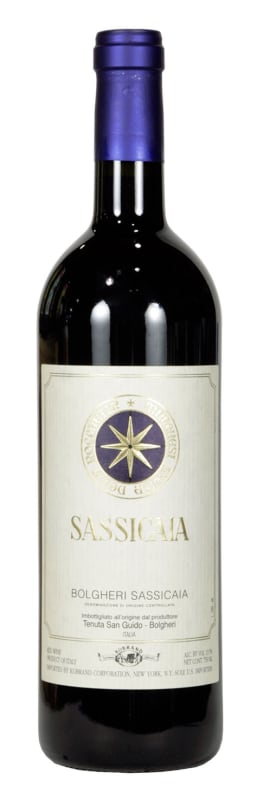


Winemaker Notes
Since the late 1960s, Sassicaia has represented a standard of production that is without compromise. The grapes are hand picked, destemmed, crushed and fermentation is set off by natural yeasts in stainless steel tanks. For the first week, pumping over of the must takes place three times daily; during the second week, this is reduced to once daily until the end of the 14-day fermentation period. The wine is pressed from the skins and undergoes full malolactic fermentation. Aging takes place in 225-litre Allier and Tronçais oak barriques, approximately 30 percent of which are new, for 18 to 22 months depending on vintage.
Sassicaia is a unique interpretation of the Cabernet variety, a wine of great breadth, complexity and longevity. The intense blackberry and cassis aromas, offset by notes of smoke and spice, are confirmed on a palate of lush concentration underscored by firm, ripe tannins carrying into a long, elegant finish.
Professional Ratings
-
Decanter
Rich and stately reddish purple. A wine that starts to welcome with open arms, then slowly but surely the tannins tighten their grip. This is an exotic, well structured and well balanced wine that steals up on you. It clearly has a long life ahead of it. Subtle, with notes of black cherry, cedar, grilled rosemary and cigar smoke. Very beautiful, with a caressing structure that promises another good few decades to enjoy.
-
Robert Parker's Wine Advocate
The 2005 Bolgheri Sassicaia is more of an extrovert and a fast-burner. It is a reflection of a warm vintage and a more pronounced stylistic signature in terms of its winemaking approach. The effect is very beautiful, indeed, with dried cherry, plum, spice, tobacco and grilled herb. Yet, the overall messaging is focused on power and volume. The background music is hard to hear. Despite its opulence, there's less dimension to behold. Brawn trumps finesse and dark fruit covers the ethereal aromas. It is well built, however, and should hold steady for the next ten years, if not more.
-
Wine & Spirits
The cabernet franc (15 percent) here seems to wrap the cassis and black cherry richness of cabernet sauvignon with the spiciness of fresh red peppercorns. Savory and bound for several hours, this becomes silky and elegant with air, the rich fruit supported by firm, earthy tannins. Deep and impressively structured, this is suited for a decade or more in the cellar.


One of the world’s most classic and popular styles of red wine, Bordeaux-inspired blends have spread from their homeland in France to nearly every corner of the New World. Typically based on either Cabernet Sauvignon or Merlot and supported by Cabernet Franc, Malbec and Petit Verdot, the best of these are densely hued, fragrant, full of fruit and boast a structure that begs for cellar time. Somm Secret—Blends from Bordeaux are generally earthier compared to those from the New World, which tend to be fruit-dominant.

An outstanding wine region made famous by Marchese Mario Incisa della Rocchetta, who planted Cabernet Sauvignon vines for his own consumption in 1940s on his San Guido estate, and called the resulting wine, Sassicaia. Today the region’s Tuscan reds are based on Cabernet Sauvignon and Merlot, which can be made as single varietal wines or blends. The local Sangiovese can make up no more than 50% of the blends. Today Sassicaia has its own DOC designation within the Bogheri DOC appellation.