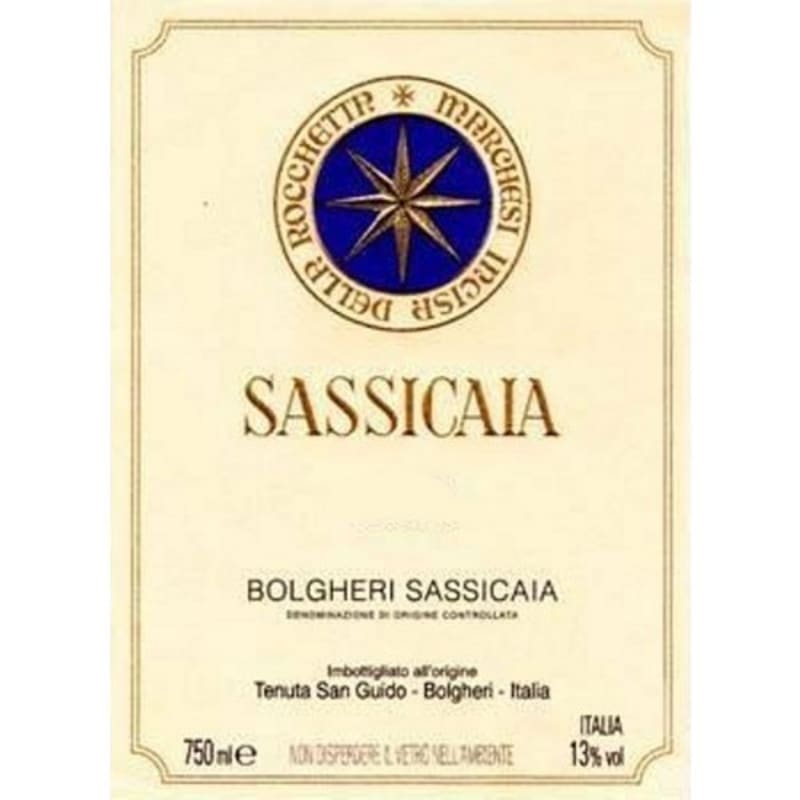

Winemaker Notes
Since the late 1960s, Sassicaia has represented a standard of production that is without compromise. The grapes are hand picked, destemmed, crushed and fermentation is set off by natural yeasts in stainless steel tanks. For the first week, pumping over of the must takes place three times daily; during the second week, this is reduced to once daily until the end of the 14-day fermentation period. The wine is pressed from the skins and undergoes full malolactic fermentation. Aging takes place in 225-litre Allier and Tronçais oak barriques, approximately 30 percent of which are new, for 18 to 22 months depending on vintage.
Sassicaia is a unique interpretation of the Cabernet variety, a wine of great breadth, complexity and longevity. The intense blackberry and cassis aromas, offset by notes of smoke and spice, are confirmed on a palate of lush concentration underscored by firm, ripe tannins carrying into a long, elegant finish.
Professional Ratings
-
Wine & Spirits
Great terroirs often prove themselves in the most extreme vintages, as Sassicaia has done in the violent heat of 2003. The vineyard produced a supple, subtle and elegant wine. To describe the fruit character one might resort to analogies with black currant and smoky black tea, but it's more a textural experience for now, a mass of pleasure, hard to grasp. Its oak treatment delivers the kind of heady richness found in young Latour; its soil character provides a completely different context, though no less grand. Probably best starting at ten to fifteen years of age, this is balanced to develop for years after that.
-
Decanter
The salinity comes through clearly at this point, which gives beautiful lift and grip. I just love how Sassicaia wines can play with tannins. They start so delicate and soft and yet close in beautifully. This has more grip and youth than the 2007. The rosemary and heat-baked herbs of Tuscany stand shoulder to shoulder with a concentrated blackberry richness and a salty tang that delivers freshness. This is the magic of Bolgheri — the coastal influence and the old vines.
-
James Suckling
This is a special Sassicaia that shows so much richness and density. Layered and ripe fruited. Hints of vanilla and wood. Full body, round texture and intense. Showing beautiful length and intensity. Drink or hold.
-
Robert Parker's Wine Advocate
The 2003 Bolgheri Sassicaia is full of unexpected twists and turns. Oddly enough, this vintage offered more overall freshness and balance than the much-celebrated 2004 edition. We all know that 2003 was a very difficult year with scorching hot temperatures that broke all records. Instead of jammy flavors or overt ripeness, this wine has embraced an all-balsam aromatic profile instead. The bouquet opens to dried cassis or red currant with eucalyptus, cola, grilled rosemary and medicinal herb. The tannins are silky and fully integrated within the wine's thick textural richness. There are areas that feel flat and sedate, but this is an impressive effort overall that shows impressive stability considering the challenges of the growing season.
-
Wine Spectator
Lots of raspberry and cherry on the nose. Full-bodied and chunky with lots of fruit and a long, velvety finish. Hints of new wood. Big and juicy Sassicaia. Very well done for the vintage. Best after 2008.
-
Wine Enthusiast
It's almost criminal to taste Sassicaia before its prime. The 2003 vintage should be ready after 2010. A blend of 85% Cab Sauvignon and 15% Cab Franc that aged 24 months in barrique, notes of cassis, exotic spice, menthol and green olive come through despite the hot vintage. It's powerful in the mouth with crispness and refined tannins.


One of the world’s most classic and popular styles of red wine, Bordeaux-inspired blends have spread from their homeland in France to nearly every corner of the New World. Typically based on either Cabernet Sauvignon or Merlot and supported by Cabernet Franc, Malbec and Petit Verdot, the best of these are densely hued, fragrant, full of fruit and boast a structure that begs for cellar time. Somm Secret—Blends from Bordeaux are generally earthier compared to those from the New World, which tend to be fruit-dominant.

An outstanding wine region made famous by Marchese Mario Incisa della Rocchetta, who planted Cabernet Sauvignon vines for his own consumption in 1940s on his San Guido estate, and called the resulting wine, Sassicaia. Today the region’s Tuscan reds are based on Cabernet Sauvignon and Merlot, which can be made as single varietal wines or blends. The local Sangiovese can make up no more than 50% of the blends. Today Sassicaia has its own DOC designation within the Bogheri DOC appellation.