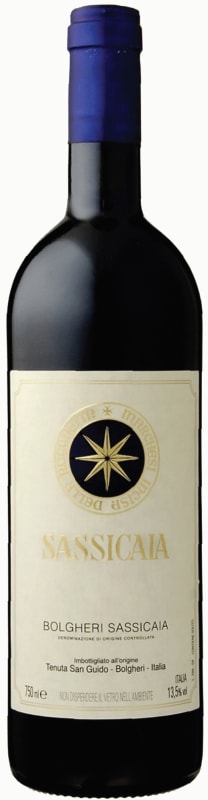


Winemaker Notes
Since the late 1960s, Sassicaia has represented a standard of production that is without compromise. The grapes are hand picked, destemmed, crushed and fermentation is set off by natural yeasts in stainless steel tanks. For the first week, pumping over of the must takes place three times daily; during the second week, this is reduced to once daily until the end of the 14-day fermentation period. The wine is pressed from the skins and undergoes full malolactic fermentation. Aging takes place in 225-litre Allier and Tronçais oak barriques, approximately 30 percent of which are new, for 18 to 22 months depending on vintage.
Sassicaia is a unique interpretation of the Cabernet variety, a wine of great breadth, complexity and longevity. The intense blackberry and cassis aromas, offset by notes of smoke and spice, are confirmed on a palate of lush concentration underscored by firm, ripe tannins carrying into a long, elegant finish.
"Dark berry fruit and exotic spice scents fill the high-toned penetrating nose...smooth tannins frame the very long finish, leaving one with the impression of persistence and balance."
-International Wine Cellar
Professional Ratings


One of the world’s most classic and popular styles of red wine, Bordeaux-inspired blends have spread from their homeland in France to nearly every corner of the New World. Typically based on either Cabernet Sauvignon or Merlot and supported by Cabernet Franc, Malbec and Petit Verdot, the best of these are densely hued, fragrant, full of fruit and boast a structure that begs for cellar time. Somm Secret—Blends from Bordeaux are generally earthier compared to those from the New World, which tend to be fruit-dominant.

An outstanding wine region made famous by Marchese Mario Incisa della Rocchetta, who planted Cabernet Sauvignon vines for his own consumption in 1940s on his San Guido estate, and called the resulting wine, Sassicaia. Today the region’s Tuscan reds are based on Cabernet Sauvignon and Merlot, which can be made as single varietal wines or blends. The local Sangiovese can make up no more than 50% of the blends. Today Sassicaia has its own DOC designation within the Bogheri DOC appellation.