

Winemaker Notes
Professional Ratings
-
James Suckling
This has a wild and perfumed nose of dried thyme, sage, blackberries, cocoa, graphite and white and green peppercorns. Then dried flowers. Full-bodied with firm, tight and precise tannins. Vibrant. There’s so much character and structure. A new benchmark for this winery. More cabernet franc than in the past. Best yet? 65% cabernet sauvignon, 25% cabernet franc and 10% merlot. Try from 2025.
-
Robert Parker's Wine Advocate
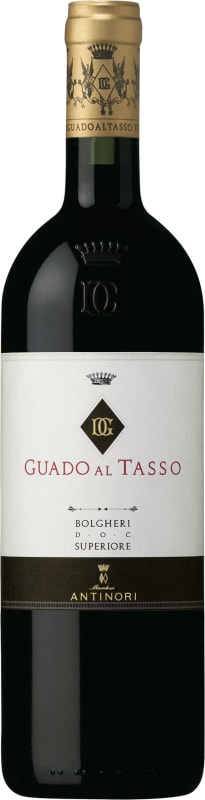
I've been tracking the increasing percentage of Cabernet Franc in the blend of this iconic Tuscan wine. The 2019 Bolgheri Superiore Guado al Tasso is made with 25% Cabernet Franc, with 60% Cabernet Sauvignon and 15% Merlot. That this heat-resistant grape now makes up a quarter of the blend speaks to how vintners are gearing up to counter climate change. These are intelligent choices, and you can count on this wine to maintain that level of extreme elegance and intensity that it is known for (even when Merlot was a bigger part of the blend). Indeed, this is a new and improved Guado al Tasso with focused aromas of pencil shaving, white pepper and crushed stone that frame a rich core of black fruit. A fluttering of dried mint gives lift and power to the bouquet. This is a beautifully linear and powerful red blend.
-
Wine Enthusiast
This gorgeous, full-bodied red opens with layers of aromas including camphor, pipe tobacco, oak-driven spice and ripe black-skinned fruit. Boasting structure and finesse, the intense palate delivers ripe black plum, juicy cherry, licorice and menthol framed in ultrarefined tannins and fresh acidity. Drink 2026–2039.


One of the world’s most classic and popular styles of red wine, Bordeaux-inspired blends have spread from their homeland in France to nearly every corner of the New World. Typically based on either Cabernet Sauvignon or Merlot and supported by Cabernet Franc, Malbec and Petit Verdot, the best of these are densely hued, fragrant, full of fruit and boast a structure that begs for cellar time. Somm Secret—Blends from Bordeaux are generally earthier compared to those from the New World, which tend to be fruit-dominant.

An outstanding wine region made famous by Marchese Mario Incisa della Rocchetta, who planted Cabernet Sauvignon vines for his own consumption in 1940s on his San Guido estate, and called the resulting wine, Sassicaia. Today the region’s Tuscan reds are based on Cabernet Sauvignon and Merlot, which can be made as single varietal wines or blends. The local Sangiovese can make up no more than 50% of the blends. Today Sassicaia has its own DOC designation within the Bogheri DOC appellation.