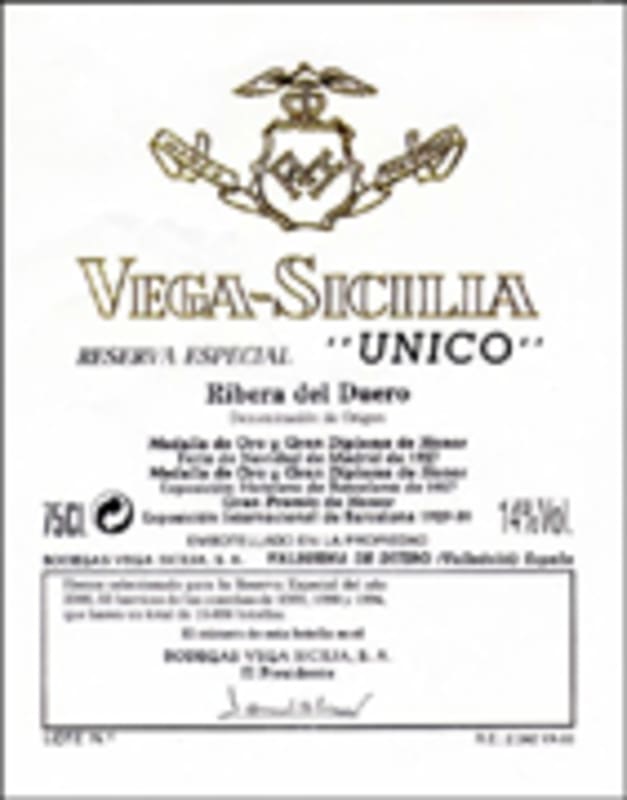

Winemaker Notes
-Wine Advocate
"Deep ruby. Complex, heady bouquet of kirsch, candied plum, cured tobacco, licorice, dried rose and cedar. Pungent herbal notes build with aeration and repeat on the palate, adding complexity to the deep, ripe cherry and dark berry liqueur flavors. Remarkably elegant wine with precise cherry/berry flavors and a slow-mounting mocha quality on the long, sappy finish. There's a very impressive interplay of fruit and tannins here."
-International Wine Cellar
Professional Ratings
-
Robert Parker's Wine Advocate
1996 was a great vintage in Ribera del Duero, following 1994 and 1995, which were not shabby either. The 1996 Único from magnum shows a classical year, still with 13.5% alcohol, with 10% Cabernet Sauvignon that gives it the characteristic balsamic undertone. The wine has great freshness and balance, and it has a lively and agile palate. Thinking back to younger vintages, it feels like there was a change after 1996. It drinks very well today and works wonders with food, but it also has a good future ahead of it, especially in magnum. This was one of my favorite modern vintages, along with 2014 and 2004.


Hailed as the star red variety in Spain’s most celebrated wine region, Tempranillo from Rioja, or simply labeled, “Rioja,” produces elegant wines with complex notes of red and black fruit, crushed rock, leather, toast and tobacco, whose best examples are fully capable of decades of improvement in the cellar.
Rioja wines are typically a blend of fruit from its three sub-regions: Rioja Alta, Rioja Alavesa and Rioja Oriental, although specific sub-region (zonas), village (municipios) and vineyard (viñedo singular) wines can now be labeled. Rioja Alta and Alavesa, at the highest elevations, are considered to be the source of the brightest, most elegant fruit, while grapes from the warmer and drier, Rioja Oriental, produce wines with deep color, great body and richness.