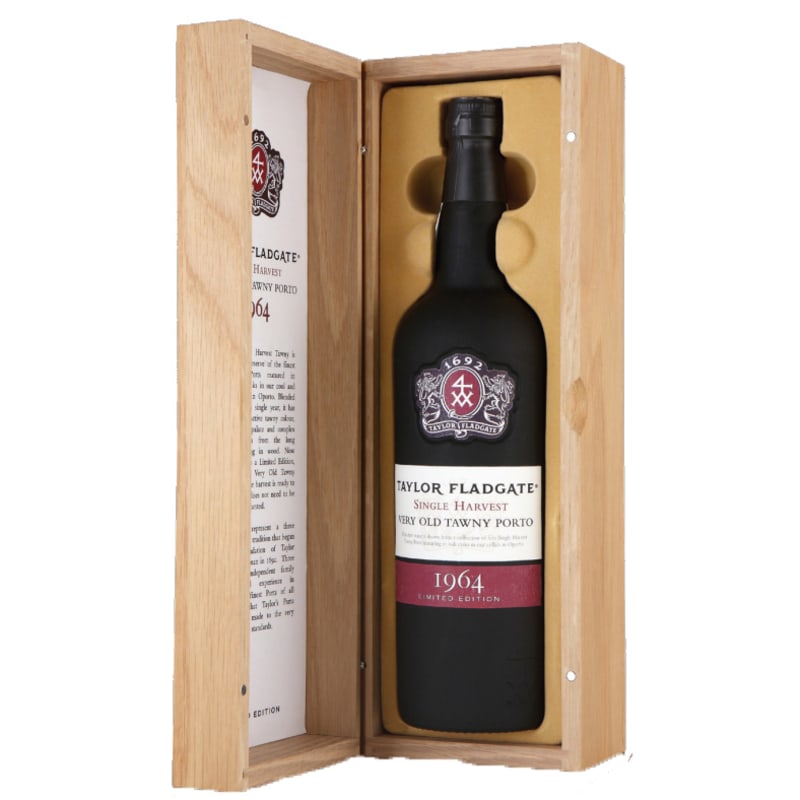

Winemaker Notes
Professional Ratings
-
Robert Parker's Wine Advocate
I allowed my glass of 1964 Taylor’s Very Old Single Harvest Port a couple of hours to open up in the glass, monitoring its evolution along the way. It is not a shy or retiring Port. Clear mahogany in color with a slight green tinge on the rim, the nose races out of the blocks like a young terrier let free in the garden, with intense aromas of grilled walnut, smoke, brown sugar, hints of caramel and a fug of alcohol that ebbs with time. The palate is smooth and honeyed on the entry, a very seductive Port wine, quite sumptuous in style, but with enough volatile lift to maintain fieriness toward the viscous finish. I speculate that had the 1963s not been so prodigious, Taylor Fladgate would have elected to follow their 1960 declaration with a 1964. That is all in the past. It is a delicious Vintage Port firing on all cylinders, ready to drink and enjoy now rather than cellar.
-
Wine Enthusiast
Properly old gold in color, this is a wine from a single year, aged in casks. It's poised between amazing fruit and a wonderful velvet texture that is shot through with acidity. A feeling of lightness comes from the acidity that gives great freshness as well as complex flavors. It's ready to drink.
-
Wine Spectator
Smooth, spicy and still fresh, with a subtly unfolding array of candied ginger, dried apple, citrus zest and marzipan flavors supported by bright acidity. Finishes with hints of anise and juniper.


Port is a sweet, fortified wine with numerous styles: Ruby, Tawny, Vintage, Late Bottled Vintage (LBV), White, Colheita, and a few unusual others. It is blended from from the most important red grapes of the Douro Valley, based primarily on Touriga Nacional with over 80 other varieties approved for use. Most Ports are best served slightly chilled at around 55-65°F. To learn more, see our full Port Wine Guide

The home of Port—perhaps the most internationally acclaimed beverage—the Douro region of Portugal is one of the world’s oldest delimited wine regions, established in 1756. The vineyards of the Douro, set on the slopes surrounding the Douro River (known as the Duero in Spain), are incredibly steep, necessitating the use of terracing and thus, manual vineyard management as well as harvesting. The Douro's best sites, rare outcroppings of Cambrian schist, are reserved for vineyards that yield high quality Port.
While more than 100 indigenous varieties are approved for wine production in the Douro, there are five primary grapes that make up most Port and the region's excellent, though less known, red table wines. Touriga Nacional is the finest of these, prized for its deep color, tannins and floral aromatics. Tinta Roriz (Spain's Tempranillo) adds bright acidity and red fruit flavors. Touriga Franca shows great persistence of fruit and Tinta Barroca helps round out the blend with its supple texture. Tinta Cão, a fine but low-yielding variety, is now rarely planted but still highly valued for its ability to produce excellent, complex wines.
White wines, generally crisp, mineral-driven blends of Arinto, Viosinho, Gouveio, Malvasia Fina and an assortment of other rare but local varieties, are produced in small quantities but worth noting.
With hot summers and cool, wet winters, the Duoro has a maritime climate.