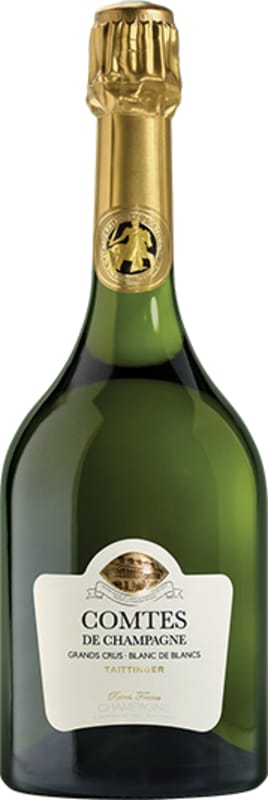


Winemaker Notes
Delicious notes of gingerbread, licorice and meringue. This Comtes de Champagne delivers aromas of delicate white fruit: vine peach, cherimoya and mandarin peel subtly blended with light touches of almond pastry.
Perfect for a special celebration, this champagne is the ideal match for a seafood, shellfish or fish entrée.
Professional Ratings
-
James Suckling
A firm, fresh Comtes with a tight and composed palate. It’s full-bodied with a racy mid-palate. Long and persistent. Very structured with phenolics and acidity. Minerally. Floral, too. Refreshing and energetic.
-
Jeb Dunnuck
The 2011 Champagne Blanc de Blancs Comte de Champagne is from all the Grand Crus of the Côte de Blancs except for Oiry. With a kiss of toasted brioche, caramel apple, and a hint of saline, this wine gets more savory as it opens, although it has a bit of greenness. The palate is full, with a fine mousse and a dusty feel of chalk, as well as fresh and pithy citrus. It has a reasonably long finish, although perhaps not up to par for the tête de cuvée. It is drinking well now but is likely best for relatively early Best After 2022.
-
Jasper Morris
A better example of the 2011, although from cork, appears to be from a later disgorgement. Classically-lean champagne with a structure and flavour profile with 20th-century resonance. The nervy citrus fruit is long and linear; the mid-palate should fill out over the next few years. But this is undoubtedly a step in the right direction in terms of presentation. Expect some aromatic up-lift and increase in complexity.
-
Wine Spectator
A minerally version, with smoke and saline notes deftly meshed with flavors of glazed apple, lemon-infused pastry cream and marzipan. This is fine and softly creamy in texture, with lemony acidity providing good definition through to the lightly toasty finish. Elegant. Drink now
-
Robert Parker's Wine Advocate
The 2011 Brut Blanc de Blancs Comtes de Champagne has generated a certain amount of controversy in critical circles, with appraisals ranging from the condemnatory to the ecstatic, so I was curious to revisit a bottle with some more time on cork. Since I tasted it last year, the wine has tightened up a little, integrating its dosage and showing more of a structural backbone. Exhibiting aromas of crisp stone fruit, buttery pastry, freshly baked bread and hints of fresh hazelnut, it's medium-bodied, pillowy and racy, with an impressively seamless palate and delicate but penetrating finish. It isn't a powerhouse, but I continue to think that it's a genuine success in a challenging year.


Representing the topmost expression of a Champagne house, a vintage Champagne is one made from the produce of a single, superior harvest year. Vintage Champagnes account for a mere 5% of total Champagne production and are produced about three times in a decade. Champagne is typically made as a blend of multiple years in order to preserve the house style; these will have non-vintage, or simply, NV on the label. The term, "vintage," as it applies to all wine, simply means a single harvest year.

Associated with luxury, celebration, and romance, the region, Champagne, is home to the world’s most prized sparkling wine. In order to bear the label, ‘Champagne’, a sparkling wine must originate from this northeastern region of France—called Champagne—and adhere to strict quality standards. Made up of the three towns Reims, Épernay, and Aÿ, it was here that the traditional method of sparkling wine production was both invented and perfected, birthing a winemaking technique as well as a flavor profile that is now emulated worldwide.
Well-drained, limestone and chalky soil defines much of the region, which lend a mineral component to its wines. Champagne’s cold, continental climate promotes ample acidity in its grapes but weather differences from year to year can create significant variation between vintages. While vintage Champagnes are produced in exceptional years, non-vintage cuvées are produced annually from a blend of several years in order to produce Champagnes that maintain a consistent house style.
With nearly negligible exceptions, . These can be blended together or bottled as individual varietal Champagnes, depending on the final style of wine desired. Chardonnay, the only white variety, contributes freshness, elegance, lively acidity and notes of citrus, orchard fruit and white flowers. Pinot Noir and its relative Pinot Meunier, provide the backbone to many blends, adding structure, body and supple red fruit flavors. Wines with a large proportion of Pinot Meunier will be ready to drink earlier, while Pinot Noir contributes to longevity. Whether it is white or rosé, most Champagne is made from a blend of red and white grapes—and uniquely, rosé is often produce by blending together red and white wine. A Champagne made exclusively from Chardonnay will be labeled as ‘blanc de blancs,’ while ones comprised of only red grapes are called ‘blanc de noirs.’