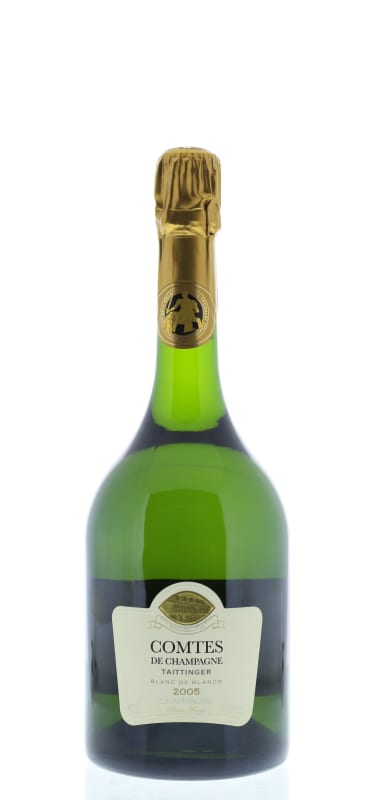


Winemaker Notes
A perfect accompaniment to first courses such as seafood and shellfish.
Professional Ratings
-
Decanter
A truly wonderful wine from the start but slow to develop in the glass this time. As usual, Taittinger succeeds very well in warm, acid-weak vintages, when neighbors' wines often appears flat and simplisitic. Despite the fact that the acidity is not particulary accenutated here either, the vineyards' aromatic citrus fresh touch leaves a fresh, uplifting side to the creamy, fat smoothness. The finish is certainly chalky and elegant , but it raises to heavenly heights with a 1976-like butterscotch soft, warm sweet flavored embracing pillow.
-
Wine Enthusiast
With just a touch of bottle age giving a toasty character, this impressive wine is already showing some maturity. That said, the apple and citrus character, the mineral tight texture and crisp acidity promise some aging. The wine conveys a sense of elegance, intensity and richness. Drink now, but the wine will also age.
-
Jasper Morris
The 2005 Comtes has a more opulent style than one usually expects from this label. A ripe vintage (more successful for Chardonnay) with similar numbers (natural ABV and pH) compared to 2006 (another ripe vintage), yet the two wines couldn't be more different. The phenolic structure of the vintage 2005 promotes fruit at the expense of some precision: The aromas of yellow plum have gained a honeyed complexity in the years since release. Threatening to turn peachy-exotic, the ubiquitous toasty aromas of coffee and walnut are still there in abundance. With palate staining intensity and length, I enjoy this wine for following a different stylistic narrative, and it is an excellent expression of this vintage. Very good indeed
-
Wine Spectator
Shows lovely balance, with a chinalike backbone of acidity, finely meshed with a creamy mousse and rich and toasty flavors of roasted hazelnut, creamed apple, lemon parfait and spun honey. A vein of smoky minerality echoes on the finish.
-
Robert Parker's Wine Advocate
Born of a challenging, disease-pressured season that demanded rigorous selection—yet one that nonetheless delivered considerable maturity in the weeks leading up to harvest—the 2005 Blanc de Blancs Comtes de Champagne, disgorged in 2015, is exhibiting aromas of yellow apple, juicy peach and mirabelle plum, mingling with apricot, dried flowers and buttery pastry. On the palate, the wine is full-bodied, broad and textural, with a rich core of fruit and ripe yet vibrant acids. In context, however, it is less harmonious and slightly heavier than other Comtes vintages shown at this tasting, lacking some of the usual energy and incisiveness. This is a good moment to pull the corks.
-
Wine & Spirits
A flashy, stylish blanc de blancs, this has exotic, dark tones to its mature fruit and toasty lees. Severe at first, like a brooding supermodel, this relents with air and gives a little plumpness, sharing some of its riches in a supple, elegant texture. With its heady complexity, this is a Champagne to serve with blini and smoked salmon.


Representing the topmost expression of a Champagne house, a vintage Champagne is one made from the produce of a single, superior harvest year. Vintage Champagnes account for a mere 5% of total Champagne production and are produced about three times in a decade. Champagne is typically made as a blend of multiple years in order to preserve the house style; these will have non-vintage, or simply, NV on the label. The term, "vintage," as it applies to all wine, simply means a single harvest year.

Associated with luxury, celebration, and romance, the region, Champagne, is home to the world’s most prized sparkling wine. In order to bear the label, ‘Champagne’, a sparkling wine must originate from this northeastern region of France—called Champagne—and adhere to strict quality standards. Made up of the three towns Reims, Épernay, and Aÿ, it was here that the traditional method of sparkling wine production was both invented and perfected, birthing a winemaking technique as well as a flavor profile that is now emulated worldwide.
Well-drained, limestone and chalky soil defines much of the region, which lend a mineral component to its wines. Champagne’s cold, continental climate promotes ample acidity in its grapes but weather differences from year to year can create significant variation between vintages. While vintage Champagnes are produced in exceptional years, non-vintage cuvées are produced annually from a blend of several years in order to produce Champagnes that maintain a consistent house style.
With nearly negligible exceptions, . These can be blended together or bottled as individual varietal Champagnes, depending on the final style of wine desired. Chardonnay, the only white variety, contributes freshness, elegance, lively acidity and notes of citrus, orchard fruit and white flowers. Pinot Noir and its relative Pinot Meunier, provide the backbone to many blends, adding structure, body and supple red fruit flavors. Wines with a large proportion of Pinot Meunier will be ready to drink earlier, while Pinot Noir contributes to longevity. Whether it is white or rosé, most Champagne is made from a blend of red and white grapes—and uniquely, rosé is often produce by blending together red and white wine. A Champagne made exclusively from Chardonnay will be labeled as ‘blanc de blancs,’ while ones comprised of only red grapes are called ‘blanc de noirs.’