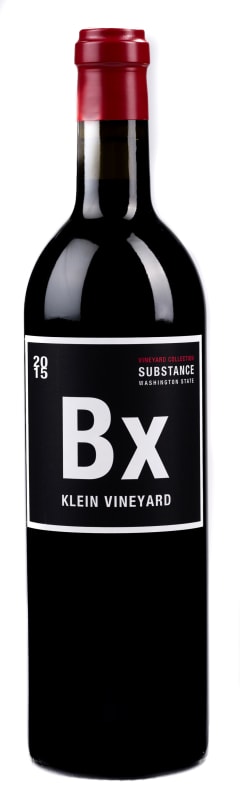


Winemaker Notes
Density is the order of the day, blue, red, black is the color. The structure is serious given what fills it. Grilled meat, Dried herbs, cigar box, black cherries, ribbon of minerality and a sense of place that could only be this wine. This is no BS. It is BX!
Blend: 45% Cabernet Sauvignon, 28% Merlot, and 27% Cabernet Franc.
Professional Ratings
-
Jeb Dunnuck
Lastly, the 2015 Klein BX Vineyard Collection checks in as a blend of 45% Cabernet Sauvignon, 28% Merlot, and the balance Cabernet Franc, brought up in a mix of new and used barrels. Deep purple-colored, with a thrilling bouquet of crème de cassis, toasted spice, graphite, and dried tobacco, this beauty hits the palate with medium to full-bodied richness, building yet sweet tannins, flawless balance, and a finish that goes on for over a minute. This is a tour de force in Bordeaux blends from Washington State that I wish every reader could taste. It’s already accessible, with a sexy, flamboyant personality, yet it’s going to keep for two decades given its balance and purity.
-
James Suckling
This has a forest-like nose with bracken, leaves, red berries, juniper and herbs, all interwoven. The palate has a sleek, graphite-like edge and dark berries are cast in forthright, muscular and intense tannins that hold uncompromising on the finish. A field blend of cabernet sauvignon, merlot and cabernet franc. Try from 2022.
-
Robert Parker's Wine Advocate
A blend of about half Cabernet Sauvignon and about a quarter each of Merlot and Cabernet Franc, the 2015 Klein Vineyard Bx opens with a bold and intense expression on the nose. The wine is full-bodied and lush on the palate, with an open-knit expression and massive, tangy tannins that land heavily on the palate and weigh it down. This is still tight and will perform better in time, so let it rest in the cellar to give this big boy time to round off its edges. 260 cases produced. Rating: 93+


One of the world’s most classic and popular styles of red wine, Bordeaux-inspired blends have spread from their homeland in France to nearly every corner of the New World. Typically based on either Cabernet Sauvignon or Merlot and supported by Cabernet Franc, Malbec and Petit Verdot, the best of these are densely hued, fragrant, full of fruit and boast a structure that begs for cellar time. Somm Secret—Blends from Bordeaux are generally earthier compared to those from the New World, which tend to be fruit-dominant.

Responsible for some of Washington’s most highly acclaimed wines, the Walla Walla Valley has experienced a surge in popularity in recent years and is home to both historic wineries and younger, up-and-coming producers.
The Walla Walla Valley, a Native American name meaning “many waters,” is located in southeastern Washington; part of the appellation actually extends into Oregon. Soils here are well-drained, sandy loess over Missoula Flood deposits and fractured basalt.
It is a region perfectly suited to Rhône-inspired Syrahs, distinguished by savory notes of red berry, black olive, smoke and fresh earth. Cabernet Sauvignon and Merlot create a range of styles from smooth and supple to robust and well-structured. White varieties are rare but some producers blend Sauvignon Blanc with Sémillon, resulting in a rich and round style, and plantings of Viognier, while minimal, are often quite successful.
Of note within Walla Walla, is one new and very peculiar appellation, called the Rocks District of Milton-Freewater. This is the only AVA in the U.S. whose boundaries are totally defined by the soil type. Soils here look a bit like those in the acclaimed Rhône region of Chateauneuf-du-Pape, but are large, ancient, basalt cobblestones. These stones work in the same way as they do in Chateauneuf, absorbing and then radiating the sun's heat up to enhance the ripening of grape clusters. The Rocks District is within the part of Walla Walla that spills over into Oregon and naturally excels in the production of Rhône varieties like Syrah, as well as the Bordeaux varieties.