
Winemaker Notes
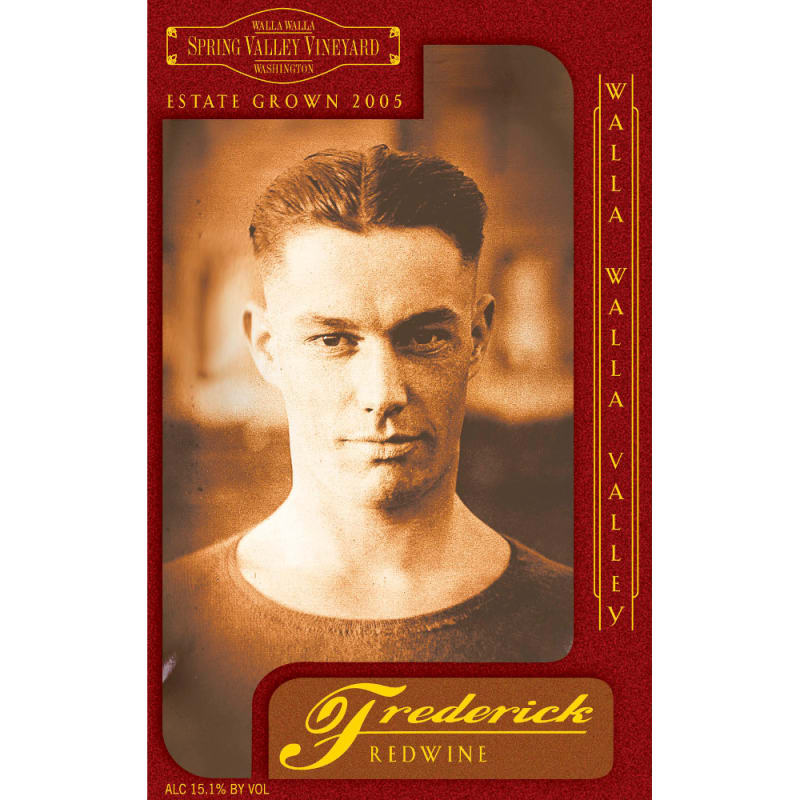
There is a lot of muscle in this fifth seductive vintage of Frederick. The nose is bright with scents of licorice and blackberry. The mouth feel is huge with a concentration of dark ripe black fruit. As usual, the tannins are richly present with exceptional quality, adding to a lingering, soft finish. This wine is enjoyable now, although I recommend opening the bottle 48 hours in advance to decant, as this wine has a very serious aging potential. ~ Serge Laville, Winemaker
Professional Ratings
-
Wine Enthusiast
The Frederick—a Bordeaux blend of 54% Cabernet Sauvignon, 40% Merlot, 5% Cab Franc and a splash of Petit Verdot—is entirely estate-grown, as are all of the Spring Valley wines. Located north of Walla Walla, in rolling wheat country, the vines attain a different set of flavors than anywhere else in the valley. It’s an unusual combination of power (15.5% alcohol) and breed. Supple, sleek, mixing its black fruits with streaks of gun metal, iron and pencil lead, this is a wine that wants to tackle a prime rib, mano à mano.





Spring Valley Vineyard is located just outside of Walla Walla, amid the scenic wheat fields of southeastern Washington. The family-owned land dates back to the late 1880’s when original owner Uriah Corkrum started farming wheat in the area. In 1993, Shari Derby, granddaughter of Uriah and husband Dean Derby planted the first grapes at Spring Valley. The first vintage of Estate grown, and bottled Spring Valley Vineyard wines were produced with the 1999 vintage. In 2007, 66 acres of new vineyards were planted & now consist of 111 acres of grapevines including Merlot, Cabernet Sauvignon, Syrah, Cabernet Franc, Petit Verdot, and Malbec.
Spring Valley was built on the strong foundation of grit, authenticity, hard work, love for the land, and love for family. The names given to the Spring Valley Vineyard Estate wines are in tribute to the family members who struggled and succeeded in farming in the same land for over 150 years. True to the family’s vision, the Spring Valley Vineyard and wheat fields are family-farmed this day to the 6th Generation. Katherine Derby, the granddaughter of Spring Valley vineyard owners Dean and Shari Derby and great-great-granddaughter of Spring Valley Founder Uriah Corkrum is carrying on the family’s legacy with leading winemaking operations – 30 years after planting the first vines.

One of the world’s most classic and popular styles of red wine, Bordeaux-inspired blends have spread from their homeland in France to nearly every corner of the New World. Typically based on either Cabernet Sauvignon or Merlot and supported by Cabernet Franc, Malbec and Petit Verdot, the best of these are densely hued, fragrant, full of fruit and boast a structure that begs for cellar time. Somm Secret—Blends from Bordeaux are generally earthier compared to those from the New World, which tend to be fruit-dominant.

Responsible for some of Washington’s most highly acclaimed wines, the Walla Walla Valley has experienced a surge in popularity in recent years and is home to both historic wineries and younger, up-and-coming producers.
The Walla Walla Valley, a Native American name meaning “many waters,” is located in southeastern Washington; part of the appellation actually extends into Oregon. Soils here are well-drained, sandy loess over Missoula Flood deposits and fractured basalt.
It is a region perfectly suited to Rhône-inspired Syrahs, distinguished by savory notes of red berry, black olive, smoke and fresh earth. Cabernet Sauvignon and Merlot create a range of styles from smooth and supple to robust and well-structured. White varieties are rare but some producers blend Sauvignon Blanc with Sémillon, resulting in a rich and round style, and plantings of Viognier, while minimal, are often quite successful.
Of note within Walla Walla, is one new and very peculiar appellation, called the Rocks District of Milton-Freewater. This is the only AVA in the U.S. whose boundaries are totally defined by the soil type. Soils here look a bit like those in the acclaimed Rhône region of Chateauneuf-du-Pape, but are large, ancient, basalt cobblestones. These stones work in the same way as they do in Chateauneuf, absorbing and then radiating the sun's heat up to enhance the ripening of grape clusters. The Rocks District is within the part of Walla Walla that spills over into Oregon and naturally excels in the production of Rhône varieties like Syrah, as well as the Bordeaux varieties.