
Winemaker Notes
Professional Ratings
-
Robert Parker's Wine Advocate
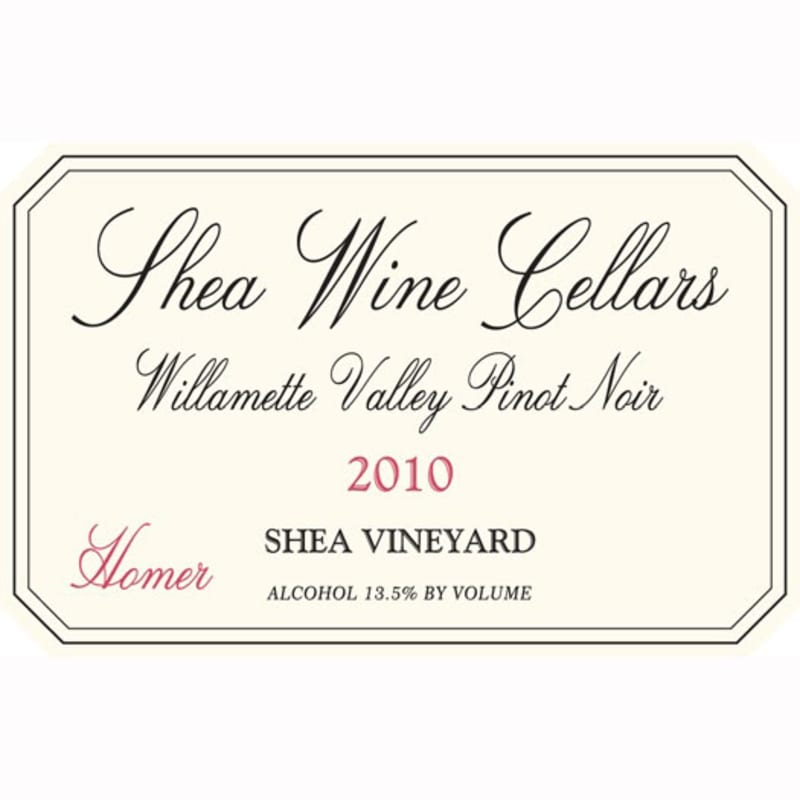
The 450 cases of Shea Cellars 2010 Pinot Noir Shea Vineyard Homer involve four blocks, only one of which also spawned a single-block bottling this vintage, feature all three of the vineyard's dominant selections or clones. "We look for our best barrels here," explains Shea, "but now that we've been doing this (bottling) for ten years, we're discovered that the flavor profile we want and what we’re trying to do with it seems mostly to come from the same blocks in the vineyard every year" – all, incidentally, on the upper-elevation west side, and dominated in aggregate by Wadenswil – "so now we sort of have in mind in advance what's going into 'Homer.'" Mint, bay laurel, smoky nut oils, and violet fascinatingly accent the ripe dark berries in this alluringly scented and polished, expansive, palpably extract-rich as well as downright energetic Pinot that easily (i.e. almost undetectably) digests its diet of 80% new oak. Billowing inner-mouth perfume; richness and concentrated fruit without heaviness; and an exhilarating ping to the long, mouthwatering finish all make for a memorable experience that should be deliciously replicable over at least the next 12-15 years.
-
Wine Spectator
Darker and richer than most 2010s, but sleek, offering dark berry, sassafras and clove flavors that mingle effortlessly against modest tannins. Lingering finish.


Thin-skinned, finicky and temperamental, Pinot Noir is also one of the most rewarding grapes to grow and remains a labor of love for some of the greatest vignerons in Burgundy. Fairly adaptable but highly reflective of the environment in which it is grown, Pinot Noir prefers a cool climate and requires low yields to achieve high quality. Outside of France, outstanding examples come from in Oregon, California and throughout specific locations in wine-producing world. Somm Secret—André Tchelistcheff, California’s most influential post-Prohibition winemaker decidedly stayed away from the grape, claiming “God made Cabernet. The Devil made Pinot Noir.”

Yamhill-Carlton, characterized by pastoral, rolling hills composed of shallow, quick-draining, ancient marine soil, is ideal for Pinot noir and other cool-climate-loving varieties. It is in the rain shadow of the Coast Range to its west, whose highest point climbs to an altitude of 3,500 feet. Yamhill-Carlton is actually surrounded by mountains on three sides: Chehalem Mountains to the north, the Dundee Hills to the east and the western Coast Range to its west, which, when it lets Pacific air through, serves to cool the region.
Vineyards grow on the ridges surrounding the two small communities of Yamhill and Carlton and cover about 1,200 acres of this 60,000 acre region, which roughly makes a horse-shoe shape on a map.