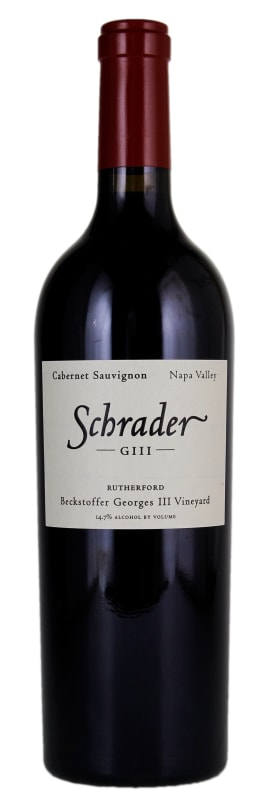


Winemaker Notes
The Schrader GIII is always a standout in our portfolio because the unique soil structure of the Beckstoffer Georges III Vineyard consistently provides a distinctive bright red fruit character. Beautifully aromatic, the Schrader GIII reveals a melange of bramble fruits and blueberries mixed with graphite notes and sweet spice. This wine truly wraps the senses and delivers an abundance of fruit to the palate that carries through to a round, satisfying finish.
Professional Ratings
-
Jeb Dunnuck
Yields at Schrader are down a massive 50%, yet what they put in bottle is certainly brilliant. Starting with their 2017 Cabernet Sauvignon Beckstoffer Georges III Vineyard, it’s one of the plusher, more rounded, sexy wines in the lineup and is loaded with cassis and assorted blue fruits as well as notes of white flowers, violets, and tobacco. Full-bodied, concentrated, and opulent on the palate, it’s one big mouthful of pleasure bent fruit that’s hard to match in the vintage. Made from 100% Cabernet Sauvignon that spent 20 months in 90% new oak, it’s going to put a smile on everyone’s face any time over the coming 20 years or so.
-
Robert Parker's Wine Advocate
Schrader’s GIII comes from Beckstoffer’s Georges III vineyard in Rutherford, produced from 337 clone grown on the F block. One hundred percent Cabernet Sauvignon, it was aged in 100% new oak for 20 months. Very deep purple-black colored, the 2017 Cabernet Sauvignon GIII Beckstoffer Georges III Vineyard comes roaring out of the glass with vivacious black cherry cordial, crème de cassis and blueberry pie scents with hints of menthol, licorice, mocha and spice cake. Medium to full-bodied, the palate is chock-full of spicy black fruit preserves, framed by plush tannins and plenty of freshness, finishing long. 294 cases were made.


A noble variety bestowed with both power and concentration, Cabernet Sauvignon enjoys success all over the globe, its best examples showing potential to age beautifully for decades. Cabernet Sauvignon flourishes in Bordeaux's Medoc where it is often blended with Merlot and smaller amounts of some combination of Cabernet Franc, Malbecand Petit Verdot. In the Napa Valley, ‘Cab’ is responsible for some of the world’s most prestigious, age-worthy and sought-after “cult” wines. Somm Secret—DNA profiling in 1997 revealed that Cabernet Sauvignon was born from a spontaneous crossing of Cabernet Franc and Sauvignon Blanc in 17th century southwest France.

The Rutherford sub-region of Napa Valley centers on the town of Rutherford and covers some of Napa Valley’s finest vineyard real estate, spanning from the Mayacamas in the west, to the Vaca Mountains on the other side of the valley.
Inside of the Rutherford AVA, bordering the Mayacamas, is a stretch of uplands called the Rutherford Bench. (These bench lands technically run the length of Oakville as well). Mountain runoff creates deep, well-drained, alluvial soils on the bench, giving vine roots plenty of reason to permeate deep into the ground. The result is wine with great structure and complexity.
Rutherford Cabernet Sauvingons and Bordeaux Blends garner substantial attention for their enticing fragrances of dusty earth and dried herbs, broad and juicy mid-palates and lush and fine-grained tannins. The sub-appellation claims some of the valley’s most prized vineyards today, namely Caymus, Rubicon and Beckstoffer Georges III.
It is also home to Napa’s most influential and historic personalities. Thomas Rutherford, responsible for the appellation's name, made serious investments here in grape growing and wine production between the years of 1850 to 1880. Gustave Niebaum purchased a large swath of land and completed his winery in 1887, calling it “Inglenook.” Today this remains the oldest bonded winery in California. Georges Latour founded Beaulieu Vineyard in 1900, making it the oldest continuous winery in the state. Latour also hired the famous enologist, André Tchelistcheff, a man credited for single-handedly defining the modern Napa winemaking style.