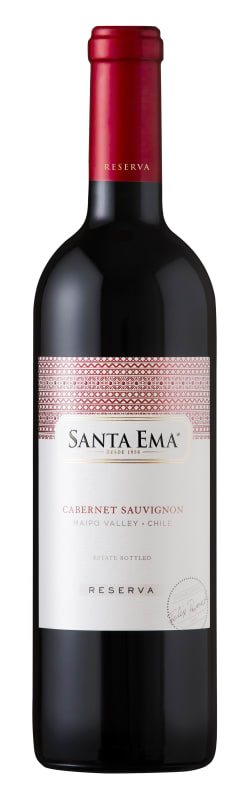


Winemaker Notes
Santa Ema Reserva Cabernet Sauvignon is a deep ruby red-violet color, with elegant and sophisticated aromas of black fruit like cherry and plum that mix with hints of tobacco and toasted coffee.
The palate is well-rounded and structured, with ripe, silky tannins that make it ideal to accompany grilled meats, stews, and aged cheeses.
Professional Ratings
-
James Suckling
This has an earthy character with notes of black cherries, cassis, blue flowers, raw mushroom and asphalt. Medium-bodied with chalky tannins and juicy, mouthwatering acidity. Lightly spiced with a mineral finish. Drink or hold.


Vinos Santa Ema is, hands-down, one of the best value/quality brands from Chile,
offering one of strongest quality-to-price wine brands in the world today. Santa Ema’s founding
Pavone family trace their history in Chile back to 1917 when they first came to the region as
grape farmers. Nearly 100 years and four generations of hands-on experience gives Santa Ema
a deep understanding of the Maipo Valley’s unique terroir. The family has established a 500 acre viticultural ‘path’ from the Andes Mountains to the Pacific Ocean, featuring the best terroir from each zone of Maipo: Alt a, Medio and Costa (Leyda). Extensive and selective vineyard ownership allows for creativity and innovation in the vineyards and winery, while guaranteeing quality control. The result is a collection of generous, elegant, regionally distinct wines that overdeliver. Winemaking: The portfolio commences with the excellent value offering, Select Terroir Reserva, which offers excellent fruit concentration, purity of its origin and unmistakable varietal typicity. The next tier up is Sant a Ema’s Reserva/Gran Reserva range. This is the winery’s most traditional and best known collection. Consistently awarded with medals and scores, including a coveted spot on the Wine Spectator Top 100. Perfect harmony and complexity are achieved through delicate barrel aging plus bottle aging. The Am plus line plays on the Latin word for ‘important, sophisticated, distinguished and honorable’. Amplus wines represent the union of tradition and modernity. These are exciting wines with tremendous complexity and elegance.

A noble variety bestowed with both power and concentration, Cabernet Sauvignon enjoys success all over the globe, its best examples showing potential to age beautifully for decades. Cabernet Sauvignon flourishes in Bordeaux's Medoc where it is often blended with Merlot and smaller amounts of some combination of Cabernet Franc, Malbecand Petit Verdot. In the Napa Valley, ‘Cab’ is responsible for some of the world’s most prestigious, age-worthy and sought-after “cult” wines. Somm Secret—DNA profiling in 1997 revealed that Cabernet Sauvignon was born from a spontaneous crossing of Cabernet Franc and Sauvignon Blanc in 17th century southwest France.

The Maipo Valley is Chile’s most famous wine region. Set in the country’s Central Valley, it is warm and quite dry, often necessitating the use of irrigation. Alluvial soils predominate but are supplemented with loam and clay.
The climate in Maipo is best-suited for ripe, full-bodied reds like Cabernet Sauvignon (the region’s most widely planted grape), Merlot, Syrah and Carmenère, a Bordeaux variety that has found a successful home in Chile.
White wines are also produced with great prosperity, especially near the cooler coast, include Chardonnay and Sauvignon Blanc.