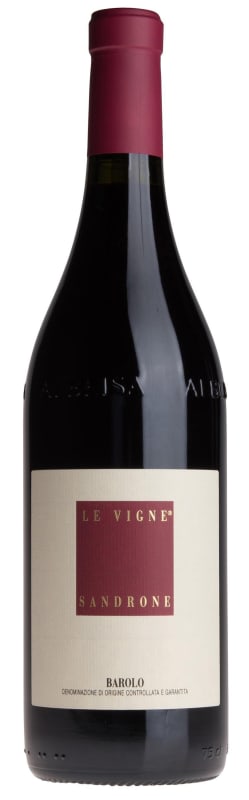


Winemaker Notes
#91 James Suckling Top 100 Wines of the World 2025
Ancient art. Barolo Le Vigne represents Sandrone's interpretation of the tradition of the Langhe and Barolo: that of the ancient and skillful art of blending Nebbiolo from several vineyards. They have taken up this historical custom working only with indigenous yeasts and keeping the grapes separate until the final assembly and blending, instead of mixing them during the fermentation phase.
Professional Ratings
-
James Suckling
This is an austere wine that’s complex and multilayered, with aromas of fresh red currants, red cherries, violets and a hint of licorice. Graphite dominates the flavors, with a full body, firm velvety tannins and long, juicy, energetic and perfectly woven acidity. Polished, elegant finish. Drinkable now, but best from 2026.
-
Robert Parker's Wine Advocate
This is a blend of fruit from Le Costa di Monforte in Monforte d'Alba, Baudana in Serralunga d'Alba, Villero in Castiglione Falletto, Vignane in Barolo and Merli in Novello. That wide span of fruit across various exposures, elevations and soil types becomes the Luciano Sandrone 2021 Barolo Le Vigne. I always have special affection for this wine, and between the Aleste and Le Vigne, this is my preferred bottle. I love the brightness and focus of the fruit, the pretty complexity and the rich mouthfeel. The fruit aromas are laced with licorice, cola and spice. The high notes are quite apparent in this excellent vintage. I came back to taste this wine 24 hours later and found those notes to be just as intense and beautiful.
Rating: 97+ -
Vinous
The 2021 Barolo Le Vigne is a classy, seamless wine. Crushed flowers, bright red-toned fruit, blood orange, mint, spice and kirsch open gracefully in the glass. This is such an elegant, sophisticated Barolo. The recent shift of sites to Serralunga and Monforte, along with longer ferments, has transformed the Le Vigne into a darker, more somber wine, while the inclusion of stems in some lots adds aromatic dimension. Le Vigne is a wine in movement.
Rating: 97+ -
Jeb Dunnuck
The 2021 Barolo Le Vigne is a jeweled ruby color and opens to expressive floral aromatics of black raspberries, fresh cherries, licorice, floral perfume, and a pretty note of cedar. The palate is incredible, with fantastically layered depth of intensity, energy, and purity. It has a lot of personality and structure, with a delicate warmth and lasting incense noted perfume on the finish. A blend of five vineyards, it has a symphonic, complete feel in this vintage. Drink 2026-2046.
-
Wine Spectator
Eucalyptus, juniper and tar notes mingle with cherry, raspberry and plum fruit in this dense red. Assertive tannins hold court on the finish, with a light yet not overbearing astringency. It’s all driven by beautiful acidity, leaving a lasting aftertaste. Best from 2029 through 2048.


Responsible for some of the most elegant and age-worthy wines in the world, Nebbiolo, named for the ubiquitous autumnal fog (called nebbia in Italian), is the star variety of northern Italy’s Piedmont region. Grown throughout the area, as well as in the neighboring Valle d’Aosta and Valtellina, it reaches its highest potential in the Piedmontese villages of Barolo, Barbaresco and Roero. Outside of Italy, growers are still very much in the experimentation stage but some success has been achieved in parts of California. Somm Secret—If you’re new to Nebbiolo, start with a charming, wallet-friendly, early-drinking Langhe Nebbiolo or Nebbiolo d'Alba.

The center of the production of the world’s most exclusive and age-worthy red wines made from Nebbiolo, the Barolo wine region includes five core townships: La Morra, Monforte d’Alba, Serralunga d’Alba, Castiglione Falletto and the Barolo village itself, as well as a few outlying villages. The landscape of Barolo, characterized by prominent and castle-topped hills, is full of history and romance centered on the Nebbiolo grape. Its wines, with the signature “tar and roses” aromas, have a deceptively light garnet color but full presence on the palate and plenty of tannins and acidity. In a well-made Barolo wine, one can expect to find complexity and good evolution with notes of, for example, strawberry, cherry, plum, leather, truffle, anise, fresh and dried herbs, tobacco and violets.
There are two predominant soil types here, which distinguish Barolo from the lesser surrounding areas. Compact and fertile Tortonian sandy marls define the vineyards farthest west and at higher elevations. Typically the Barolo wines coming from this side, from La Morra and Barolo, can be approachable relatively early on in their evolution and represent the “feminine” side of Barolo, often closer in style to Barbaresco with elegant perfume and fresh fruit.
On the eastern side of the Barolo wine region, Helvetian soils of compressed sandstone and chalks are less fertile, producing wines with intense body, power and structured tannins. This more “masculine” style comes from Monforte d’Alba and Serralunga d’Alba. The township of Castiglione Falletto covers a spine with both soil types.
The best Barolo wines need 10-15 years before they are ready to drink, and can further age for several decades.