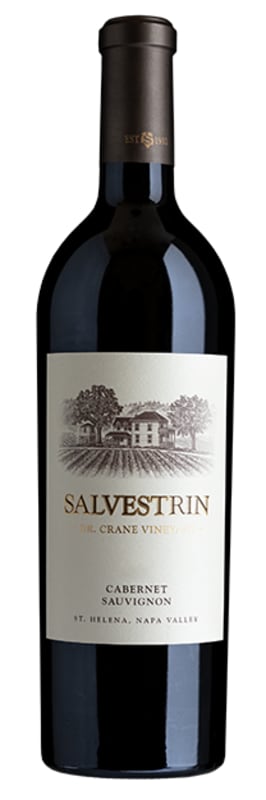


Winemaker Notes
Salvestrin's approach for the Dr. Crane Vineyard Estate Cabernet Sauvignon emphasizes balance and elegance instead of power and opulence. The texture is velvety without compromising its inherent Cabernet weight, the mid palate is juicy and the finish persistently chalky yet polished. Hints of barrel tones including baking spice and vanilla on the palate mingle with notes of red plum and fennel.
Blend: 85% Cabernet Sauvignon, 9% Merlot, 6% Cabernet Franc
Professional Ratings
-
Robert Parker's Wine Advocate
Picked well before the Glass Fire (between September 5th and 18th), the 2020 Cabernet Sauvignon Dr. Crane Vineyard is a blend of 85% Cabernet Sauvignon, 9% Merlot and 6% Cabernet Franc. Cherry fruit dominates, although there are hints of darker fruit, cigar box and mocha. Full-bodied and richly concentrated, this is a clear step up from the Napa bottling, finishing long, lush and velvety, with a deep, earthy undercurrent.
-
James Suckling
Aromas of ripe purple fruit with savory herbs, dried flowers, dried citrus peel and chocolate. Full-bodied, deep and structured with succulent fruit and firm, chalky tannins. Lingering finish. Try from 2025.
-
Wine Spectator
Sedate in style but well-defined and alluring, with a caressing feel to the mix of plum and boysenberry puree notes, joined by light violet, sweet bay leaf and singed vanilla accents. Picks up a nice tug of earth through the finish. Drink now through 2035.
-
Wine Enthusiast
Dense tannins and a chocolaty, espresso-like concentration give this full-bodied wine plenty of potential for aging. Black fruits and dark chocolate are laced together with a sandy texture that holds them tightly now.


A noble variety bestowed with both power and concentration, Cabernet Sauvignon enjoys success all over the globe, its best examples showing potential to age beautifully for decades. Cabernet Sauvignon flourishes in Bordeaux's Medoc where it is often blended with Merlot and smaller amounts of some combination of Cabernet Franc, Malbecand Petit Verdot. In the Napa Valley, ‘Cab’ is responsible for some of the world’s most prestigious, age-worthy and sought-after “cult” wines. Somm Secret—DNA profiling in 1997 revealed that Cabernet Sauvignon was born from a spontaneous crossing of Cabernet Franc and Sauvignon Blanc in 17th century southwest France.

St. Helena is in the heart of the Napa Valley, nestled between Calistoga to the north and Rutherford on its southern border. On its western side, the Mayacamas Mountains guard it from the cooling effects of the Pacific Ocean; to its east stand the Vaca Mountains. In conjunction, these mountain ranges serve to lock in summer daytime heat. But in the evening, cool air from the San Pablo Bay funnels up through the valley, creating very chilly nights. It isn’t uncommon for temperatures to drop 50 degrees, a shift that promotes a balance of sugar ripeness and acidity in wine grapes.
St. Helena contains a plethora of different soil types in a small area, which have been enhanced over centuries by rain runoff from both mountain ranges. Its vineyards cover a variety of terrain, spreading across the bucolic valley floor and its benchlands.
These ideal topographic and climatic growing conditions easily caught the attention of early winemaking pioneers. In fact, St. Helena is the birthplace of Napa Valley’s commercial wine industry. Dr. Crane founded his cellar in 1859, David Fulton in 1860 and Charles Krug in 1861.
Today there are no less than 400 separate vineyards planted within the 12,000 acres that make up the St. Helena appellation.
Revered most for its red wines based on Bordeaux varieties, namely Cabernet Sauvignon, the St. Helena appellation is also a source of superior Syrah, Zinfandel and Sauvignon blanc.