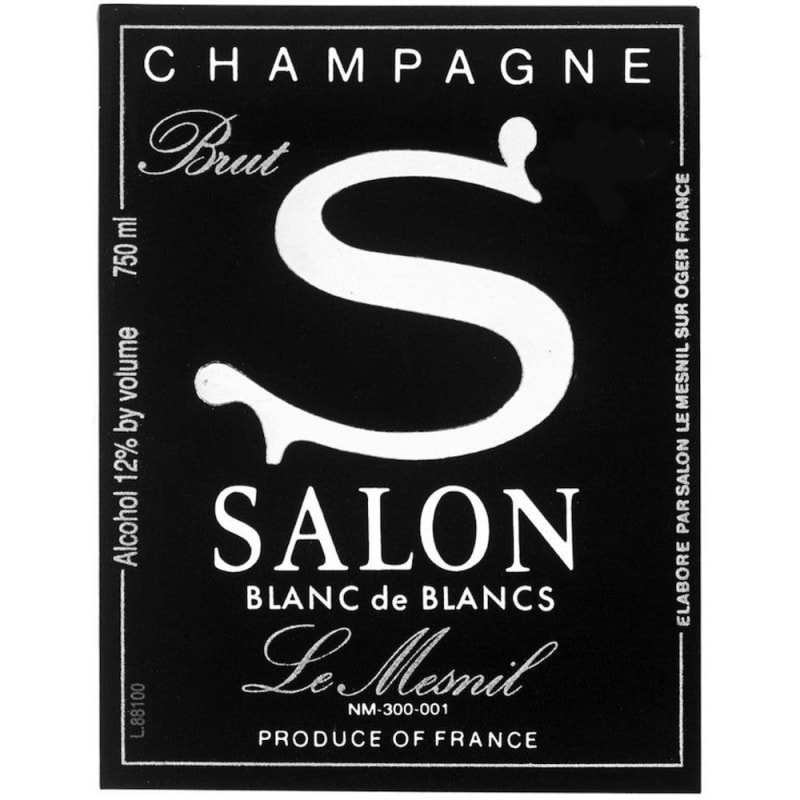

Winemaker Notes
Wonderfully refined, it is intriguing and enticing, its minerality complemented by hints of white flowers, acacia andhawthorn. A salty note enhances aromas of bread crust, brioche and the merest hint of green apple and hazelnut.
The palate is quintessentially pure, the very epitome of balance and restraint. Exuberant onentry, the mousse becomes more of a caress, while bubbles dance playfully on the palate.Elegance, finesse, bright vitality, depth and power allied with a lightness of touch—itis difficult to encapsulate so many complementary and contradictory elements comingtogether in harmony.
Refined, feminine and seductive, voluptuous yet restrained, and superblybalanced, this vintage compares stylistically to the great 1988.
According to Didier Depond, Director of the House of Champagne Salon, this singularwine should be served in a tulip-shaped glass rather than a narrow champagne flute. He says,"We have found that Salon can be drunk in the same way as a great wine. Due to therichness and complexity of its aromas and its exceptional, lingering finish, this style ofglass allows the wine to breathe more freely.
Professional Ratings
-
Connoisseurs' Guide
That these wines are both expensive and superb as a class comes as no surprise, and yet, even in the midst of such excellence, this bottling stands out for its full, rich, developed, incisively toasty first notes followed by deep, rich, chalky, hazelnut, honey and nicely fruity smells and flavors of extraordinary depth and volume. It captures a perfect mix of richness in its mousse and texture with the slight austerity one wants in Champagne, and, for all of its complexity, it promises to unwind further with age.
-
Wine Enthusiast
The fabled Salon's latest release is much riper and softer than the great steely 1996 vintage. This suggests it is likely to be ready to drink soon. In the meantime, the acidity is supremely fresh, with grapefruit edges and green apple flavors. And then there is minerality and a tight, structured aftertaste as a reminder that this great Champagne is always going to be more than its fruit.
-
Wine & Spirits
The pure essence of limestone, this vintage is maturing into the grandeur of a great Le Mesnil Champagne while remaining fresh and lively. It offers rich lemon curd and baked apple flavors, chalky power and gravitas without weight. The flavors remain impacted below the limestone earthiness, the wine's structure and balance suited to extended aging.
-
Wine Spectator
A delicate Champagne, with hints of honey and smoke winding through the apple pastry, orange peel and toast flavors. This is well-integrated, but the lively acidity still has the edge on the graphite-laced finish. Drink now through 2018. Tasted twice, with consistent notes.


Representing the topmost expression of a Champagne house, a vintage Champagne is one made from the produce of a single, superior harvest year. Vintage Champagnes account for a mere 5% of total Champagne production and are produced about three times in a decade. Champagne is typically made as a blend of multiple years in order to preserve the house style; these will have non-vintage, or simply, NV on the label. The term, "vintage," as it applies to all wine, simply means a single harvest year.

Associated with luxury, celebration, and romance, the region, Champagne, is home to the world’s most prized sparkling wine. In order to bear the label, ‘Champagne’, a sparkling wine must originate from this northeastern region of France—called Champagne—and adhere to strict quality standards. Made up of the three towns Reims, Épernay, and Aÿ, it was here that the traditional method of sparkling wine production was both invented and perfected, birthing a winemaking technique as well as a flavor profile that is now emulated worldwide.
Well-drained, limestone and chalky soil defines much of the region, which lend a mineral component to its wines. Champagne’s cold, continental climate promotes ample acidity in its grapes but weather differences from year to year can create significant variation between vintages. While vintage Champagnes are produced in exceptional years, non-vintage cuvées are produced annually from a blend of several years in order to produce Champagnes that maintain a consistent house style.
With nearly negligible exceptions, . These can be blended together or bottled as individual varietal Champagnes, depending on the final style of wine desired. Chardonnay, the only white variety, contributes freshness, elegance, lively acidity and notes of citrus, orchard fruit and white flowers. Pinot Noir and its relative Pinot Meunier, provide the backbone to many blends, adding structure, body and supple red fruit flavors. Wines with a large proportion of Pinot Meunier will be ready to drink earlier, while Pinot Noir contributes to longevity. Whether it is white or rosé, most Champagne is made from a blend of red and white grapes—and uniquely, rosé is often produce by blending together red and white wine. A Champagne made exclusively from Chardonnay will be labeled as ‘blanc de blancs,’ while ones comprised of only red grapes are called ‘blanc de noirs.’