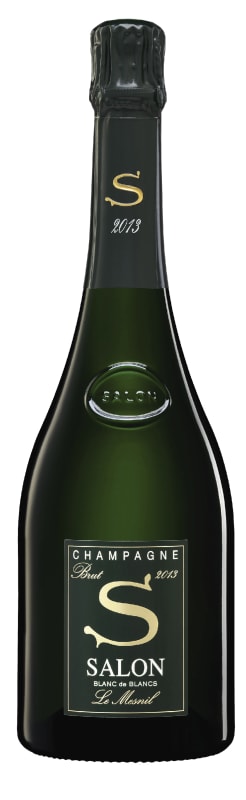


Winemaker Notes
In natural light Salon 2013 offers a radiant robe, while golden nuances dance with glints of green in the glass, a reliable indication of a superb Blanc de Blancs. White blossom, linden flowers, jasmine and bergamot zest form its bouquet, laced with the classic minerality of Le Mesnil. The magnitude of the terroir emerges, both subtle and profound. At once rich and long, the palate shows perfect balance, its power contained. The warm character of the vintage is tangible, boasting good structure with elegant rounded aromas of baked apple, toasted hazelnut and salted butter caramel. The chalky, mouth-watering finish buoyed by the evanescent bubbles carries the Salon signature. The wine’s origins have the final say: Le Mesnil is expressed in the forthright, consummate and finely honed character; Salon 2013 unveils an unexpected strength that springs forth.
Professional Ratings
-
Vinous
The 2013 is the most powerful, dense young Salon I have ever tasted. Champagne of mind-bending complexity, the 2013 possesses tremendous mid-palate intensity and power from the very first taste. Lemon confit, dried flowers, mint and a touch of brioche appear first, followed by light tropical accents that add an exotic flair. Imagine the sizzling energy of the 2008 and the persistence of 2004, with more mid-palate richness and riper fruit. Two-thousand thirteen was a cool, late ripening year. Harvest started at the beginning of October under sunny, dry days and cool nights, conditions that have not been seen since then. Readers will find a spectacular, modern Salon endowed with tremendous depth and very little of the youthful austerity that once defined Champagnes from cooler years here. The 5.5 grams per liter of dosage is perfectly judged. In a word: Magnificent.
-
Jeb Dunnuck
A vintage that’s not widely recognized following the 2012 vintage, the 2013 Champagne Blanc De Blancs Salon Brut pours a bright yellow/silver hue and opens in the glass to forward notes of chalky earth, ripe tangerine, and white pepper. Ripe on the palate, it is powerful upfront, with a long finish and fresh acidity. It displays a nice balance of creamy texture and mousse, with mouthwatering acidity, and like most vintages of Salon, it’s going to take time. Its texture is salty and crunchy, and the wine is very well-balanced, with a touch of warmth on the finish. Compared to the 2012, it has a slightly more rounded feel and warmth but retains great Mesnil character. Dosage was 5 grams per liter. 60,000 bottles were produced.
-
Decanter
The first impression upon release in September 2023 is of surprisingly open, welcoming fragrance for young Salon; orange cream, floral honey and lemon peel, backed up with delicate browned pastry, milky oyster and nut oil complexity that speaks of the long lees ageing. It is taut rather than austere, with a delicate, even level of flesh on its rigid bones as the classic chalky marine squeeze of Le Mesnil takes hold and propels a long, detailed lemon peel finish. This could prove a classic Salon given considerable patience.
-
James Suckling
Impressive yet very subtle aromas of flint, chalk, stone and honeysuckle, as well as gun powder. Medium body with a solid core of fruit, yet very refined and silky, with a delicate and refined finish. Pure and terroir-driven. Disgorged in 2023.
-
Robert Parker's Wine Advocate
The 2013 Brut Blanc de Blancs Le Mesnil continues its ascent and, even with just a couple of extra years in bottle, is already revealing different facets, expressing itself from the glass with aromas of citrus oil, white flowers, fresh hazelnut and freshly baked bread, mingled with marine inflections and a faint hint of mango. On the palate, it is full-bodied, ample and concentrated, underpinned by ripe yet racy acidity, animated by a pinpoint mousse and concluding with a resonant, chalky finish. While not fundamentally different, it is slightly tauter and more incisive in the context of the 2015; yet it possesses no austerity and will hardly disappoint those who choose to open a bottle in the mid-term. That said, it is undeniable that it will continue to gain depth with further aging, with no risk of deterioration. Rating: 96+
-
Wine Spectator
A graceful Champagne, with pleasing plushness to the finely detailed mousse, revealing a delicate honeyed overtone to the notes of apricot tart, lemon curd, white blossoms and smoked almond. Shows a rich, underlying streak of chalky minerality that emerges to drive the lacy finish. Drink now through 2038.


Representing the topmost expression of a Champagne house, a vintage Champagne is one made from the produce of a single, superior harvest year. Vintage Champagnes account for a mere 5% of total Champagne production and are produced about three times in a decade. Champagne is typically made as a blend of multiple years in order to preserve the house style; these will have non-vintage, or simply, NV on the label. The term, "vintage," as it applies to all wine, simply means a single harvest year.

Associated with luxury, celebration, and romance, the region, Champagne, is home to the world’s most prized sparkling wine. In order to bear the label, ‘Champagne’, a sparkling wine must originate from this northeastern region of France—called Champagne—and adhere to strict quality standards. Made up of the three towns Reims, Épernay, and Aÿ, it was here that the traditional method of sparkling wine production was both invented and perfected, birthing a winemaking technique as well as a flavor profile that is now emulated worldwide.
Well-drained, limestone and chalky soil defines much of the region, which lend a mineral component to its wines. Champagne’s cold, continental climate promotes ample acidity in its grapes but weather differences from year to year can create significant variation between vintages. While vintage Champagnes are produced in exceptional years, non-vintage cuvées are produced annually from a blend of several years in order to produce Champagnes that maintain a consistent house style.
With nearly negligible exceptions, . These can be blended together or bottled as individual varietal Champagnes, depending on the final style of wine desired. Chardonnay, the only white variety, contributes freshness, elegance, lively acidity and notes of citrus, orchard fruit and white flowers. Pinot Noir and its relative Pinot Meunier, provide the backbone to many blends, adding structure, body and supple red fruit flavors. Wines with a large proportion of Pinot Meunier will be ready to drink earlier, while Pinot Noir contributes to longevity. Whether it is white or rosé, most Champagne is made from a blend of red and white grapes—and uniquely, rosé is often produce by blending together red and white wine. A Champagne made exclusively from Chardonnay will be labeled as ‘blanc de blancs,’ while ones comprised of only red grapes are called ‘blanc de noirs.’