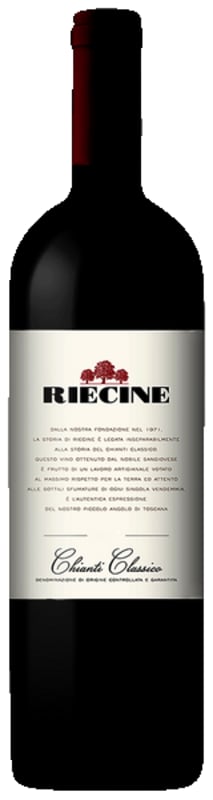


Winemaker Notes
Riecine's first wine, first bottled 50 years ago, remains faithful to itself, representing an idea of a pleasantly austere Chianti Classico, equally suited to drinking at lunch or ageing for decades. That's thanks to the Sangiovese, which develops every year while always staying true to its natural temperament and elegance. After selection in the vineyard and on the vibrating sorting table, the grapes are delicately destemmed, then transferred to Nomblot unlined concrete tanks where they ferment for around 15 days before macerating with a submerged cap for another five. Once drawn off, the must is divided between different containers – old tonneaus, to limit the extraction of tannins from the wood; large untoasted Grenier casks; concrete tanks – and remains in them for around 12 months, before returning, blended, to large outdoor concrete tanks. Here the wine undergoes tartaric stabilization and the final natural fining for another 3 months before being bottled.
Professional Ratings
-
James Suckling
Black cherry and violet aromas with hints of lemon peel. Crushed stone as well. Medium body, well integrated tannins and a creamy texture of lovely tannins and fruit.
-
Wine Spectator
Intense aromas and flavors of cherry, raspberry and spices mark this succulent, harmonious red, which firms up nicely on the finish, where iron and tobacco accents emerge. Drink now through 2028. 3,750 cases made, 2,700 cases imported.
-
Decanter
Riecine’s 2021 annata is jubilant and lively. A blend of high-altitude vineyards in Gaiole, this includes some whole berries for a semi-carbonic maceration. The fermentation is spontaneous with indigenous yeasts in concrete tanks, and refinement continues in a combination of unlined concrete vats and large untoasted oak barrels. It boasts becoming scents of raspberry, potting soil, rose and cherry blossoms. midweight and transparent, the palate brings in flavours of red currants and orange peel. The light tannins are powdery in texture, and racy acidity electrifies with nervous energy.
-
Wine Enthusiast
The nose starts with fruit aromas of blood orange and wild cherries and strawberries, then turns umami with notes of balsamic, mushrooms and damp soil. On the sweet, juicy, full palate the fruit returns and plays well with the acid, while firm yet flexible tannins provide structure.
-
Jeb Dunnuck
A deep ruby/purple color, the 2021 Chianti Classico is exuberant in the glass, with leaping aromas of cherry lozenge, mint, resinous herbs, and sassafras. Medium-bodied, with ripe tannins and a savory earthiness of black tea on the palate, it’s a very charming and well-made entry to the range that readers should not feel rushed to drain from the cellar. In a good place now, it is going to benefit from another 6 months to a year's time.


Among Italy's elite red grape varieties, Sangiovese has the perfect intersection of bright red fruit and savory earthiness and is responsible for the best red wines of Tuscany. While it is best known as the chief component of Chianti, it is also the main grape in Vino Nobile di Montepulciano and reaches the height of its power and intensity in the complex, long-lived Brunello di Montalcino. Somm Secret—Sangiovese doubles under the alias, Nielluccio, on the French island of Corsica where it produces distinctly floral and refreshing reds and rosés.

One of the first wine regions anywhere to be officially recognized and delimited, Chianti Classico is today what was originally defined simply as Chianti. Already identified by the early 18th century as a superior zone, the official name of Chianti was proclaimed upon the area surrounding the townships of Castellina, Radda and Gaiole, just north of Siena, by Cosimo III, Grand Duke of Tuscany in an official decree in 1716.
However, by the 1930s the Italian government had appended this historic zone with additonal land in order to capitalize on the Chianti name. It wasn’t until 1996 that Chianti Classico became autonomous once again when the government granted a separate DOCG (Denominazione di Origine Controllata e Garantita) to its borders. Ever since, Chianti Classico considers itself no longer a subzone of Chianti.
Many Classicos are today made of 100% Sangiovese but can include up to 20% of other approved varieties grown within the Classico borders. The best Classicos will have a bright acidity, supple tannins and be full-bodied with plenty of ripe fruit (plums, black cherry, blackberry). Also common among the best Classicos are expressive notes of cedar, dried herbs, fennel, balsamic or tobacco.