


Winemaker Notes
Blend: 85% Touriga Nacional, 10% Touriga Franca and 5% Tinta Barca.
Professional Ratings
-
Wine & Spirits
The concept of this wine descended from Fernando Nicolau de Almeida, who created Ferreira’s Barca Velha, the first modern Douro red, by blending fruit from the vineyard along the banks of the upper Douro (now Vale Meão) with grapes from cooler high-altitude sites. His son, João, became managing director of Ramos Pinto, where Champagne Roederer helped to finance Nicolau de Almeida’s experimentation with a blend from two estate-owned vineyards in the Douro Superior: Ervamoira, on the banks of the Coa River, and Bons Ares, a cool, high-altitude site. This is the last vintage of Duas Quintas made under his watch before he retired, and one of the best. It sparks with mineral intensity, fat and rich enough in the middle to support all that schist-driven tannic power. Up above, a violet scent introduces the wine and lingers in the midst of a complex finish. The flavors modulate between black and purple, the youthfulness of the fruit primed to evolve for a decade or more.
-
Robert Parker's Wine Advocate
The 2015 Duas Quintas Reserva has been seen before, but at a much earlier stage. It is mostly Touriga Nacional, with dollops of Touriga Franca (10%) and Tinta da Barca (5%), aged for 12 months in barriques of varying ages and nationalities. This is just gorgeous in its understated way, a classic of the vintage, something that exemplifies what nature gave in 2015. It has beautiful mid-palate finesse. It's not big, deep and rich, but it is fresh, vivid in flavor and impeccably balanced. The fruit is lifted and nicely defined. It feels like a barrel sample even today. I suspect this will age quite well. If it is on the lighter side in concentration, its freshness and balance will serve it well in the cellar. People often underestimate the aging ability of lighter-styled but very fresh wines. It's pretty delicious and approachable right now, but I suspect it will get even better with a little cellaring.
-
Wine Spectator
Full-bodied, offering a polished core of blackberry reduction, currant and hot stone flavors nicely accented by anise, black chocolate and soy sauce elements. Tannic, with a lingering finish.
-
Decanter
Complex but a bit closed. Youthful tannins warming alcohol ripe black fruit everything needed to come together with time.



Founded by Adriano Ramos Pinto in 1880, Casa Ramos Pinto rapidly became noted, at the time, for its innovative and enterprising strategy. Associated with quality bottled wines, it began operating on the Brazilian market in the early 20th century and quickly became responsible for half of the wine exported to South America, whilst it was still conquering generations of loyal customers in Portugal and Europe. These were the natural results of a forward thinking strategy, based on the modernisation of selection, batching and ageing circuits, and the special care which Adriano Ramos Pinto devoted to the packaging and promotion of his wines.
Aware that the quality of its wines were confined to the earth of the wine producing Douro, Casa Ramos Pinto meticulously studied this Demarcated Region, and eventually became the owners of a number of estates with very special characteristics. The objective was to ensure the control and quality of the whole production process. By perfecting its wines, Ramos Pinto created unique nectars with its own signature.
In 1990, Casa Ramos Pinto became part of the Roederer Group, whose history has identical characteristics. The qualities that gave fame to Casa Ramos Pinto now took on an international dimension.

With hundreds of red grape varieties to choose from, winemakers have the freedom to create a virtually endless assortment of blended red wines. In many European regions, strict laws are in place determining the set of varieties that may be used, but in the New World, experimentation is permitted and encouraged resulting in a wide variety of red wine styles. Blending can be utilized to enhance balance or create complexity, lending different layers of flavors and aromas. For example, a red wine blend variety that creates a fruity and full-bodied wine would do well combined with one that is naturally high in acidity and tannins. Sometimes small amounts of a particular variety are added to boost color or aromatics. Blending can take place before or after fermentation, with the latter, more popular option giving more control to the winemaker over the final qualities of the wine.
How to Serve Red Wine
A common piece of advice is to serve red wine at “room temperature,” but this suggestion is imprecise. After all, room temperature in January is likely to be quite different than in August, even considering the possible effect of central heating and air conditioning systems. The proper temperature to aim for is 55° F to 60° F for lighter-bodied reds and 60° F to 65° F for fuller-bodied wines.
How Long Does Red Wine Last?
Once opened and re-corked, a bottle stored in a cool, dark environment (like your fridge) will stay fresh and nicely drinkable for a day or two. There are products available that can extend that period by a couple of days. As for unopened bottles, optimal storage means keeping them on their sides in a moderately humid environment at about 57° F. Red wines stored in this manner will stay good – and possibly improve – for anywhere from one year to multiple decades. Assessing how long to hold on to a bottle is a complicated science. If you are planning long-term storage of your reds, seek the advice of a wine professional.

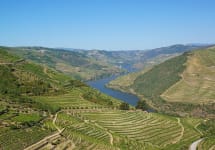
The home of Port—perhaps the most internationally acclaimed beverage—the Douro region of Portugal is one of the world’s oldest delimited wine regions, established in 1756. The vineyards of the Douro, set on the slopes surrounding the Douro River (known as the Duero in Spain), are incredibly steep, necessitating the use of terracing and thus, manual vineyard management as well as harvesting. The Douro's best sites, rare outcroppings of Cambrian schist, are reserved for vineyards that yield high quality Port.
While more than 100 indigenous varieties are approved for wine production in the Douro, there are five primary grapes that make up most Port and the region's excellent, though less known, red table wines. Touriga Nacional is the finest of these, prized for its deep color, tannins and floral aromatics. Tinta Roriz (Spain's Tempranillo) adds bright acidity and red fruit flavors. Touriga Franca shows great persistence of fruit and Tinta Barroca helps round out the blend with its supple texture. Tinta Cão, a fine but low-yielding variety, is now rarely planted but still highly valued for its ability to produce excellent, complex wines.
White wines, generally crisp, mineral-driven blends of Arinto, Viosinho, Gouveio, Malvasia Fina and an assortment of other rare but local varieties, are produced in small quantities but worth noting.
With hot summers and cool, wet winters, the Duoro has a maritime climate.