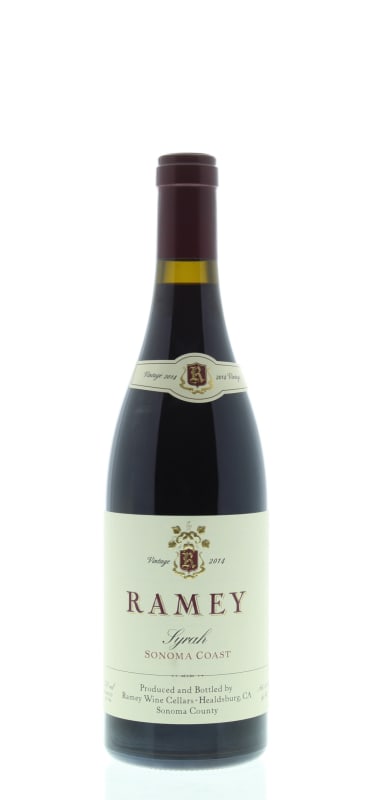


Winemaker Notes
Blend: 97% Syrah and 3% Viognier, co-fermented.
Professional Ratings
-
Connoisseurs' Guide
Here is a very solid, well-defined, no-nonsense Syrah that hits the varietal mark smartly, and, if never as deep nor as impressively far-ranging as Ramey's involving, single-vineyard versions, it is long on concentrated, ripe berry fruit with inklings of sweet oak and game along with peppery spice to spare. It is structured to keep and should be allowed to quietly rest for at least four or five years, but it will not begin to approach its very best until its tenth birthday nears.
-
Robert Parker's Wine Advocate
Co-fermented with 3% Viognier, the 2014 Syrah Sonoma Coast has an intense nose of crushed black cherries and black berries with floral hints of roses and potpourri, plus touches of wild thyme and garrigue. Medium-bodied, it delivers a lot of fruit and earthy flavors with rounded tannins and great length.
-
Wine Spectator
Well-structured and appealingly savory, with blueberry and smoky cured meat aromas and focused flavors of dark plum, underbrush and pepper. Drink now through 2026. 1,400 cases made.


Marked by an unmistakable deep purple hue and savory aromatics, Syrah makes an intense, powerful and often age-worthy red. Native to the Northern Rhône, Syrah achieves its maximum potential in the steep village of Hermitage and plays an important component in the Red Rhône Blends of the south, adding color and structure to Grenache and Mourvèdre. Syrah is the most widely planted grape of Australia and is important in California and Washington. Sommelier Secret—Such a synergy these three create together, the Grenache, Syrah, Mourvedre trio often takes on the shorthand term, “GSM.”

A vast appellation covering Sonoma County’s Pacific coastline, the Sonoma Coast AVA runs all the way from the Mendocino County border, south to the San Pablo Bay. The region can actually be divided into two sections—the actual coastal vineyards, marked by marine soils, cool temperatures and saline ocean breezes—and the warmer, drier vineyards further inland, which are still heavily influenced by the Pacific but not quite with same intensity.
Contained within the appellation are the much smaller Fort Ross-Seaview and Petaluma Gap AVAs.
The Sonoma Coast is highly regarded for elegant Pinot Noir, Chardonnay, and, increasingly, cool-climate Syrah. The wines have high acidity, moderate alcohol, firm tannin, and balanced ripeness.