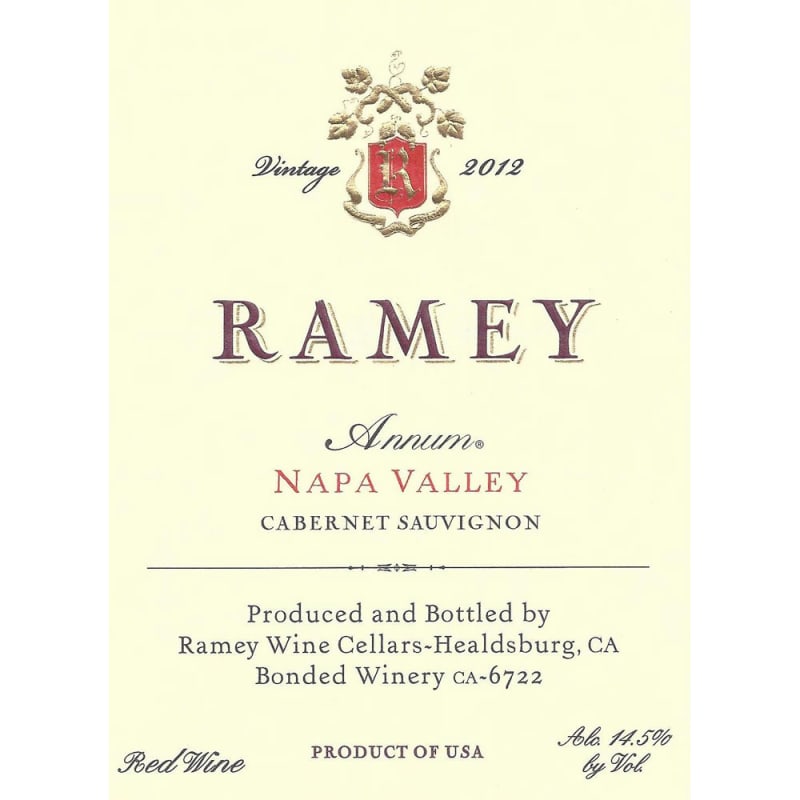

Winemaker Notes
2012 turned out to be a perfect vintage with clear sunny days and cool evenings. This produced a long, moderate growing season with extended hang time and even ripening, resulting in optimum tannin maturity and a deep range of flavors. The vintage ended with a textbook harvest starting on September 1st and ending exactly two months later on Halloween.
Professional Ratings
-
Robert Parker's Wine Advocate
The 2012 Cabernet Sauvignon Annum contains 76% Cabernet Sauvignon and 24% Cabernet Franc. It's deep ruby with wonderful aromas of laurel leaf, beef drippings, prosciutto, star anise, fenugreek, crème de cassis and crushed black cherries with dried flowers and a sanguine/iron streak. Medium to full-bodied, the palate offers that Ramey lushness, fully fruited, spiced and rounded in the mouth with wonderfully ripe, fine-grained tannins and good freshness, finishing very long and layered. This seems to have only just shed its baby fat.
-
Wine Spectator
A firm, dense, powerful Cabernet, offering chewy dried berry, sage, underbrush, cedary oak and anise flavors, gaining on the finish, where the flavors are expansive and persistent. Drink now through 2029.
-
James Suckling
This is a cabernet with lots of currant and berry character. Full and rich. Long finish. Savory. Drink or hold.
-
Wine Enthusiast
A blend of 75% Cabernet Sauvignon and 25% Cabernet Franc from a sweet vineyard spot near Dalle Valle, this is a lovely, softly textured wine. Shy on the nose yet powerful on the palate, it offers a burst of tightly wound tannin and leather at the fore. Chocolate and dried herb with a layering of black licorice give it a dark complexion and build. Be sure to mellow it in the cellar, through 2022.
Cellar Selection.


One of the most prestigious wines of the world capable of great power and grace, Napa Valley Cabernet is a leading force in the world of fine, famous, collectible red wine. Today the Napa Valley and Cabernet Sauvignon are so intrinsically linked that it is difficult to discuss one without the other. But it wasn’t until the 1970s that this marriage came to light; sudden international recognition rained upon Napa with the victory of the Stag’s Leap Wine Cellars 1973 Cabernet Sauvignon in the 1976 Judgement of Paris.
Cabernet Sauvignon undoubtedly dominates Napa Valley today, covering half of the land under vine, commanding the highest prices per ton and earning the most critical acclaim. Cabernet Sauvignon’s structure, acidity, capacity to thrive in multiple environs and ability to express nuances of vintage make it perfect for Napa Valley where incredible soil and geographical diversity are found and the climate is perfect for grape growing. Within the Napa Valley lie many smaller sub-AVAs that express specific characteristics based on situation, slope and soil—as a perfect example, Rutherford’s famous dust or Stags Leap District's tart cherry flavors.