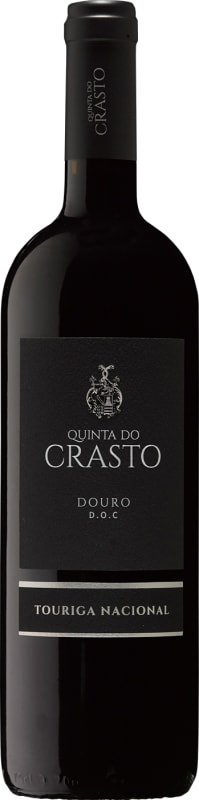


Winemaker Notes
The grapes come from the best Touriga Nacional plots of Quinta do Crasto. Extraordinary fresh on the nose, showing lovely aromas of violet and wild berry fruit. The palate is elegant and evolves into a wine that shows excellent volume and a solid structure made of lively and fine-textured tannins. This is an appealing wine that finishes with great balance, freshness and persistence.
Professional Ratings
-
Robert Parker's Wine Advocate
The exuberant, showy, perfumed and floral 2020 Touriga Nacional is a textbook example of the modern interpretation of the variety. It's ripe (14.5% alcohol), generous and combines freshness with power, mixing grapes from north and south expositions. They selected the best grapes, from two plots planted in 1985, and fermented them destemmed with indigenous yeasts in stainless steel tanks. It matured in French oak barrels for 18 months. It's juicy, has a velvety palate, a soft mouthfeel and round, elegant tannins, tasty and long. This is the most famous grape from Portugal at the moment. It's approachable but has the ingredients and the balance between them to age gracefully.
-
Wine Spectator
A fresh, well-knit red, with pretty violet, anise and mountain herb aromatics lacing the ripe and juicy blackberry, boysenberry and black cherry fruit, plus integrated, muscular tannins. This is compact today but still offers enjoyable expression and length. It’s hard to wait, but this will shine with sometime in the cellar.
-
James Suckling
Inky color. Quite ripe on the nose, with black dates, licorice, ripe blackberries, black cherries, graphite and dark chocolate. Full-bodied and concentrated, with structured, fine-grained tannins, a flavorful center palate and a long and brooding finish. Ambitiously crafted. Vegan.



Nestled on a privileged location in the Douro, Quinta do Crasto is one of the oldest winemaking estates in the region – the name ‘Crasto’ is derived from the Latin word ‘castrum’, which means ‘Roman fort’. The first known references to Quinta do Crasto can be traced back to 1615, long before the Douro became the world’s first Demarcated Wine Region in 1756. In the early 1900s, Quinta do Crasto was purchased by Constantino de Almeida, the founder of the famous Constantino Port house. Today, his granddaughter, Leonor Roquette, and her husband Jorge Roquette own and manage the estate, together with their sons, Miguel and Tomás. The Roquette family has invested tremendous time, attention, and resources to rebuild and expand the vineyards and facilities to produce top quality Port and Douro table wines. Vineyard mapping, DNA-matched replanting, a new state-of-the-art wine cellar and centuries of tradition mean that no detail in the winemaking and vineyard management is overlooked.
Quinta do Crasto produces different styles of port and table wines each year. Together with their winemakers and their entire team, they seek to produce year after year wines that display the unique and beautiful characteristics of the Douro, through a tireless devotion to tradition, integrity and excellence.

Gaining great popularity for its bold but beautifully aromatic dry red wines, Touriga Nacional is the noblest variety in Port wine. Most likely originating from the Dão region, today it grows throughout the Douro Valley as well. Somm Secret—As many as 80 grape varieties can be used to make Port wine, each contributing something unique to the resulting blend. Touriga Nacional adds great color, tannins and aromatics.

The home of Port—perhaps the most internationally acclaimed beverage—the Douro region of Portugal is one of the world’s oldest delimited wine regions, established in 1756. The vineyards of the Douro, set on the slopes surrounding the Douro River (known as the Duero in Spain), are incredibly steep, necessitating the use of terracing and thus, manual vineyard management as well as harvesting. The Douro's best sites, rare outcroppings of Cambrian schist, are reserved for vineyards that yield high quality Port.
While more than 100 indigenous varieties are approved for wine production in the Douro, there are five primary grapes that make up most Port and the region's excellent, though less known, red table wines. Touriga Nacional is the finest of these, prized for its deep color, tannins and floral aromatics. Tinta Roriz (Spain's Tempranillo) adds bright acidity and red fruit flavors. Touriga Franca shows great persistence of fruit and Tinta Barroca helps round out the blend with its supple texture. Tinta Cão, a fine but low-yielding variety, is now rarely planted but still highly valued for its ability to produce excellent, complex wines.
White wines, generally crisp, mineral-driven blends of Arinto, Viosinho, Gouveio, Malvasia Fina and an assortment of other rare but local varieties, are produced in small quantities but worth noting.
With hot summers and cool, wet winters, the Duoro has a maritime climate.