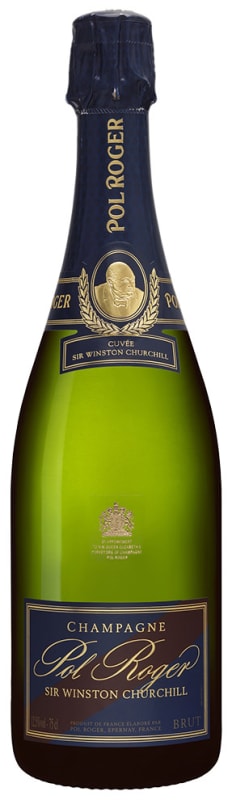


Winemaker Notes
The weight, balance and mineral freshness means that this champagne could be served with Parmigano Reggiano matured for 18 months, a stuffed capon “facon demi-deuil” or sweetbreads cooked with morels.
Professional Ratings
-
Decanter
Sir Winston is looking particularly dignified and refined in 2004, with a surprisingly primary, youthful air, yet all the understated poise that one can expect of this classic cuvée. A cascade of impeccably refined acidity swirls into a river of minerality that flows deep and swift all the way to the distant horizon. Effortless grace and youthful vigour lurk under that distinguished exterior. Dense grilled nuts nose, backward and youthful, and shows aromatic depth at the expense of immediate charm. The palate is rich, broad, and weighty, very concentrated, achieving a majestic style that's biscuitty and powerful. Although accessible now it will certainly improve with more bottle age that will allow the flavours to unfurl. Long.
-
Wine Enthusiast
Following on from the great 2002 vintage of this wine, the 2004 is equally memorable. It is a magnificent wine, structured and beautifully balanced between the ripe white fruits and the tight texture that will allow it to age many years. While drinkable now, it is still young at 11 years, still with great potential. Drink now, until 2024, and probably beyond.
-
James Suckling
This has trademark richness, power and complexity with a layer of spiced grilled hazelnuts and brown-mushroom aromas set across lemon, grapefruit and dried-red fruits. The palate has a full, pastry-like texture showing bold flavors and an assertively fleshy cherry and peach core. The tannins are smooth and ripe, carrying the finish long. This is framed up for further enrichment. Plenty to offer now but best from 2020 and a decade after that still.
-
Robert Parker's Wine Advocate
An intense golden-yellow color dresses the Pol Roger prestige cuvée 2004 Sir Winston Churchill, which opens with a clear, deep, dense, ripe, fresh, pure and elegant bouquet of matured apples, apricots and lemon flavors along with exciting spicy flavors. Although this Brut is already more than 11-years-old, it is dew-fresh and still developing--slowly. This Champagne is highly complex and well structured on the palate, with grapefruit flavors; it is a full-bodied and intense, yet very firm, persistent, fresh and very elegant assemblage of unnamed Grand Cru Pinot Noirs and Chardonnays. It reveals a very long and complex, powerful but stimulating finish, and obviously, an eternal youth. The finish is powerful and stringent, and reveals a great, great aging potential. The wine is somewhat restrained and too compact at the moment though, and should benefit from a longer bottle aging.
-
Wine Spectator
This creamy version has a subtle richness, folded into a fresh, elegant frame. Shows layers of crème de cassis, toast and pastry cream, with citrus peel, smoky mineral and spice accents echoing on the long finish. Drink now through 2027.


Pol Roger is one of the few remaining family-owned grande marque Champagne houses. Their grande marque status was guaranteed at the turn of the century when about 20 producers banded together to establish exacting quality controls for Champagne. The annual production at Pol Roger - less than 120,000 cases - is found in the best restaurants of France, England, and the USA, and is exported to over 30 countries. Pol Roger also was the Champagne of choice of British dignitary Sir Winston Churchill, who once said of Champagne, "...In victory I deserve it, and in defeat I need it!".

Representing the topmost expression of a Champagne house, a vintage Champagne is one made from the produce of a single, superior harvest year. Vintage Champagnes account for a mere 5% of total Champagne production and are produced about three times in a decade. Champagne is typically made as a blend of multiple years in order to preserve the house style; these will have non-vintage, or simply, NV on the label. The term, "vintage," as it applies to all wine, simply means a single harvest year.

Associated with luxury, celebration, and romance, the region, Champagne, is home to the world’s most prized sparkling wine. In order to bear the label, ‘Champagne’, a sparkling wine must originate from this northeastern region of France—called Champagne—and adhere to strict quality standards. Made up of the three towns Reims, Épernay, and Aÿ, it was here that the traditional method of sparkling wine production was both invented and perfected, birthing a winemaking technique as well as a flavor profile that is now emulated worldwide.
Well-drained, limestone and chalky soil defines much of the region, which lend a mineral component to its wines. Champagne’s cold, continental climate promotes ample acidity in its grapes but weather differences from year to year can create significant variation between vintages. While vintage Champagnes are produced in exceptional years, non-vintage cuvées are produced annually from a blend of several years in order to produce Champagnes that maintain a consistent house style.
With nearly negligible exceptions, . These can be blended together or bottled as individual varietal Champagnes, depending on the final style of wine desired. Chardonnay, the only white variety, contributes freshness, elegance, lively acidity and notes of citrus, orchard fruit and white flowers. Pinot Noir and its relative Pinot Meunier, provide the backbone to many blends, adding structure, body and supple red fruit flavors. Wines with a large proportion of Pinot Meunier will be ready to drink earlier, while Pinot Noir contributes to longevity. Whether it is white or rosé, most Champagne is made from a blend of red and white grapes—and uniquely, rosé is often produce by blending together red and white wine. A Champagne made exclusively from Chardonnay will be labeled as ‘blanc de blancs,’ while ones comprised of only red grapes are called ‘blanc de noirs.’