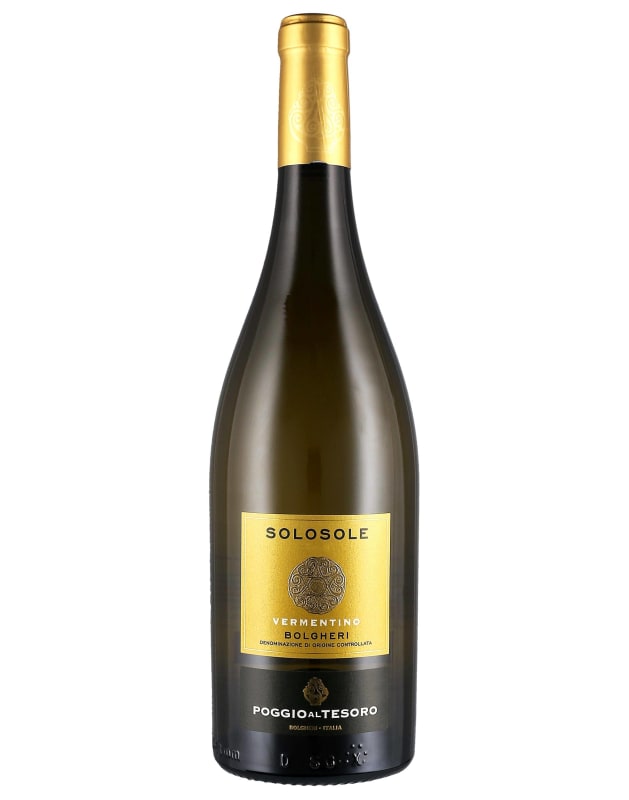


Winemaker Notes
The wine proffers intense Mediterranean aromas, expressing a textured combination of aromatic herbs and citrus notes. The palate exhibits pristine, pure Vermentino, characterized by a satisfying savoriness, minerality and a structure that promises great longevity.
This is an ideal accompaniment to both sea and lake fish, and is excellent with prestigious raw fish dishes, Livorno-style mullet, Lake Garda sardines and various refined tempura specialities. It pairs perfectly at the end of a meal with Doppia Panna soft cheeses and Tuscan Pecorino.
Professional Ratings
-
James Suckling
This is very linear and energetic with lots of fresh fruit. Lemon and lime-rind undertones. Bright acidity. Medium body. Delicious finish. Plenty of fruit and freshness.
-
Robert Parker's Wine Advocate
To make the 2017 Bolgheri Vermentino Solosole, Poggio al Tesoro sourced Vermentino clones from Corsica, rather than Tuscany. The clone has large, loose clusters that require a lot of extra work in order to manage yields; the vineyard teams do a lot of fruit selection, sometimes berry for berry. This wine is made in stainless steel. They had experimented with oak but that was abandoned. It is fermented at very low temperatures and aged on the lees. The first vintage of this popular white wine was 2006.
-
Decanter
Delightful aromas of rosemary and thyme, with persistent lemon and lime flavours on a creamy, weighty palate. Well put together.
-
Wine Enthusiast
Yellow-peach, tropical-fruit and Mediterranean brush aromas follow through to the fresh, rounded palate along with a vein of saline and white grapefruit. It’s juicy and savory, with a bitteralmond finish.


A fantastic, aromatic white grape that grows with great success in Sardinia, Tuscany and in lesser proportions on the island of Corsica. Somm Secret—Vermentino is thought to be genetically identical to Liguria’s Pigato grape and Peidmont’s Favorita. It comprises a large proportion of the whites in southern France where it is called Rolle.

One of the most iconic Italian regions for wine, scenery and history, Tuscany is the world’s most important outpost for the Sangiovese grape. Tuscan wine ranges in style from fruity and simple to complex and age-worthy, Sangiovese makes up a significant percentage of plantings here, with the white Trebbiano Toscano coming in second.
Within Tuscany, many esteemed wines have their own respective sub-zones, including Chianti, Brunello di Montalcino and Vino Nobile di Montepulciano. The climate is Mediterranean and the topography consists mostly of picturesque rolling hills, scattered with vineyards.
Sangiovese at its simplest produces straightforward pizza-friendly Tuscan wines with bright and juicy red fruit, but at its best it shows remarkable complexity and ageability. Top-quality Sangiovese-based wines can be expressive of a range of characteristics such as sour cherry, balsamic, dried herbs, leather, fresh earth, dried flowers, anise and tobacco. Brunello, an exceptionally bold Tuscan wine, expresses well the particularities of vintage variations and is thus popular among collectors. Chianti is associated with tangy and food-friendly dry wines at various price points. A more recent phenomenon as of the 1970s is the “Super Tuscan”—a red wine made from international grape varieties like Cabernet Sauvignon, Merlot, Cabernet Franc and Syrah, with or without Sangiovese. These are common in Tuscany’s coastal regions like Bolgheri, Val di Cornia, Carmignano and the island of Elba.