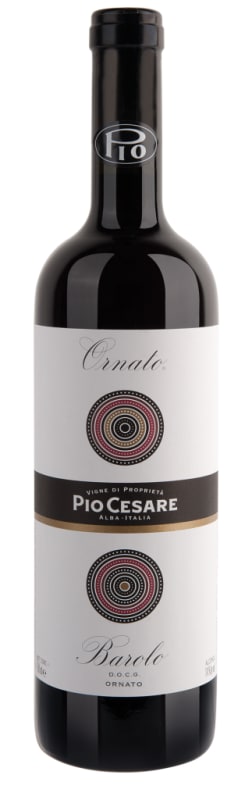


Winemaker Notes
Blend: 100% Nebbiolo
Professional Ratings
-
James Suckling
This is very focused with lots of ripe tannins in the center palate. Very velvety and fine-textured with a pointed character. Medium to full body. Aromas of plums and spices such as cinnamon and nutmeg to the fruit. Bitter citrus. Chewy at the end. Taut muscles. Sophisticated. Needs four or five years to come around. Best after 2030.
-
Decanter
Ornato has been the Pio Cesare estate's cru since 1985. In 2020, the grapes were harvested on 5 October, after the heavy rainfall. Mineral and smoky, with intense violet notes alongside cherry kernel and rhubarb, it's full of graphite flavour and almost zestiness on the palate, supported by tight-knit tannins. Polished and thick on the finish. ’Compared to 2019, we used gentler extractions in 2020,’ explains Federica Boffa, now in charge at Pio Cesare.
-
Robert Parker's Wine Advocate
The most powerful of the bunch is the Pio Cesare 2020 Barolo Ornato. This is a structured wine with firm tannins and dense fruit that falls on the darker side of the spectrum with blackberry and damson plum. You also get that typical Serralunga d'Alba imprint of rusty mineral and dark licorice. The wine is quite ample in terms of volume and depth, and iy's definitely reflective of its territory of origin.
-
Wine Enthusiast
This Barolo from the Ornato vineyard offers enticing aromas of ripe black cherry, cinnamon-spiced cake, candied blood orange zest, and a hint of fresh bay leaf. The palate is exceptionally well-balanced, with a precise, linear structure that showcases flavors of juicy blackberry, dark chocolate, and a touch of vanilla. The wine's impressive length and depth are evident in the long, satisfying finish. Drink 2026-2044.
Cellar Selection -
Wine Spectator
This is firm and tightly wound, with thick, refined tannins setting the stage for cherry, eucalyptus, tobacco and iron flavors, while dusty, mouthcoating tannins infuse the finish. Patience required for the fruit to emerge. Best from 2029 through 2050.
-
Jeb Dunnuck
The 2020 Barolo Ornato expresses a wonderful floral profile on the nose, with loads of fresh roses, red raspberries, dried strawberries, white pepper, and fennel. It displays a more linear approach compared to the Mosconi (which has broader shoulders and more structure), with fine tannins, snappy acidity, and a bright lift on the finish. It is elegant and a touch nervous at this stage and will benefit from another year in bottle. Drink 2025-2037.
-
Vinous
The 2020 Barolo Ornato is an attractive, translucent wine. Sage, mint, pipe tobacco, dried herbs and crushed rose petal play off a core of Nebbiolo fruit. Overall, I find the 2020 a bit too light for this site in the heart of Serralunga.



Pio Cesare has been producing wine for more than 100 years and through generations. The tradition began in 1881, when Pio Cesare started gathering grapes in his vineyards and purchasing those of some selected and reliable farmers in the hills of Barolo and Barbaresco districts.
At Pio Cesare, there has always been a conviction that great wine can come only from the finest grapes and the winery's output has always been limited through adherence to the highest standards. Pio Cesare limits its production by using only the most mature and healthy grapes. The ripening of the grapes is carefully monitored and the harvest is rigidly controlled with each grape selected by hand.
Today, the estate is managed by Pio Boffa, great-grandson of Pio Cesare. Under his stewardship, the wines of Pio Cesare have become famous throughout the world. Great strides have been made in quality, and single vineyard offerings have dazzled the wine press.

Responsible for some of the most elegant and age-worthy wines in the world, Nebbiolo, named for the ubiquitous autumnal fog (called nebbia in Italian), is the star variety of northern Italy’s Piedmont region. Grown throughout the area, as well as in the neighboring Valle d’Aosta and Valtellina, it reaches its highest potential in the Piedmontese villages of Barolo, Barbaresco and Roero. Outside of Italy, growers are still very much in the experimentation stage but some success has been achieved in parts of California. Somm Secret—If you’re new to Nebbiolo, start with a charming, wallet-friendly, early-drinking Langhe Nebbiolo or Nebbiolo d'Alba.

The center of the production of the world’s most exclusive and age-worthy red wines made from Nebbiolo, the Barolo wine region includes five core townships: La Morra, Monforte d’Alba, Serralunga d’Alba, Castiglione Falletto and the Barolo village itself, as well as a few outlying villages. The landscape of Barolo, characterized by prominent and castle-topped hills, is full of history and romance centered on the Nebbiolo grape. Its wines, with the signature “tar and roses” aromas, have a deceptively light garnet color but full presence on the palate and plenty of tannins and acidity. In a well-made Barolo wine, one can expect to find complexity and good evolution with notes of, for example, strawberry, cherry, plum, leather, truffle, anise, fresh and dried herbs, tobacco and violets.
There are two predominant soil types here, which distinguish Barolo from the lesser surrounding areas. Compact and fertile Tortonian sandy marls define the vineyards farthest west and at higher elevations. Typically the Barolo wines coming from this side, from La Morra and Barolo, can be approachable relatively early on in their evolution and represent the “feminine” side of Barolo, often closer in style to Barbaresco with elegant perfume and fresh fruit.
On the eastern side of the Barolo wine region, Helvetian soils of compressed sandstone and chalks are less fertile, producing wines with intense body, power and structured tannins. This more “masculine” style comes from Monforte d’Alba and Serralunga d’Alba. The township of Castiglione Falletto covers a spine with both soil types.
The best Barolo wines need 10-15 years before they are ready to drink, and can further age for several decades.