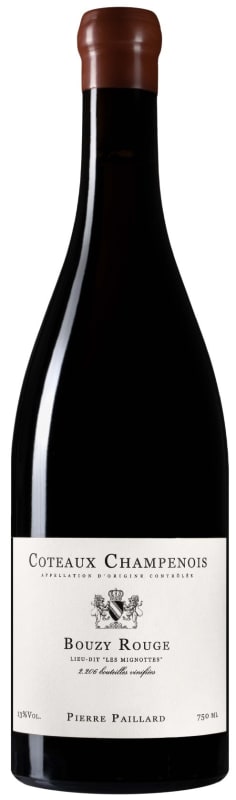


Winemaker Notes
Professional Ratings
-
Jeb Dunnuck
A very good year for their red wine, the 2022 Coteaux Champenois Grand Cru Bouzy Rouge Les Mignottes exhibits a jeweled ruby color and smells like a Tootsie Pop! Along with its notes of cherries and cocoa, it’s medium-bodied and spicy but not astringent, with savory earth, fine tannins, and a clean, balanced feel. A fabulous red wine with dark stones, mineral accents, and terrific energy lasting on the finish.
-
Wine Spectator
The aromas have a very floral undertone of lavender and violets. Raspberries and strawberries as well. Medium-bodied with fine tannins and a racy, refined finish. Lovely delicate fruit under the bright French oak.
-
Robert Parker's Wine Advocate
Sourced from the south-facing Les Mignottes lieu-dit in Bouzy, planted in 1979, Pierre Paillard’s 2022 Coteaux Champenois Bouzy Rouge Les Mignottes is showing beautifully. Matured for one year in 228-liter barrels—approximately 10% new, with the remainder ranging from one to four years old—it reveals a bouquet of ripe plums, exotic spices, violets and cherries. On the palate, it is medium to full-bodied, with a supple texture and seductive depth, delivering intensity and charm in equal measure. Already approachable, it offers considerable immediate pleasure while, much like the Champagnes from this address, hinting at further potential.


Thin-skinned, finicky and temperamental, Pinot Noir is also one of the most rewarding grapes to grow and remains a labor of love for some of the greatest vignerons in Burgundy. Fairly adaptable but highly reflective of the environment in which it is grown, Pinot Noir prefers a cool climate and requires low yields to achieve high quality. Outside of France, outstanding examples come from in Oregon, California and throughout specific locations in wine-producing world. Somm Secret—André Tchelistcheff, California’s most influential post-Prohibition winemaker decidedly stayed away from the grape, claiming “God made Cabernet. The Devil made Pinot Noir.”

Associated with luxury, celebration, and romance, the region, Champagne, is home to the world’s most prized sparkling wine. In order to bear the label, ‘Champagne’, a sparkling wine must originate from this northeastern region of France—called Champagne—and adhere to strict quality standards. Made up of the three towns Reims, Épernay, and Aÿ, it was here that the traditional method of sparkling wine production was both invented and perfected, birthing a winemaking technique as well as a flavor profile that is now emulated worldwide.
Well-drained, limestone and chalky soil defines much of the region, which lend a mineral component to its wines. Champagne’s cold, continental climate promotes ample acidity in its grapes but weather differences from year to year can create significant variation between vintages. While vintage Champagnes are produced in exceptional years, non-vintage cuvées are produced annually from a blend of several years in order to produce Champagnes that maintain a consistent house style.
With nearly negligible exceptions, . These can be blended together or bottled as individual varietal Champagnes, depending on the final style of wine desired. Chardonnay, the only white variety, contributes freshness, elegance, lively acidity and notes of citrus, orchard fruit and white flowers. Pinot Noir and its relative Pinot Meunier, provide the backbone to many blends, adding structure, body and supple red fruit flavors. Wines with a large proportion of Pinot Meunier will be ready to drink earlier, while Pinot Noir contributes to longevity. Whether it is white or rosé, most Champagne is made from a blend of red and white grapes—and uniquely, rosé is often produce by blending together red and white wine. A Champagne made exclusively from Chardonnay will be labeled as ‘blanc de blancs,’ while ones comprised of only red grapes are called ‘blanc de noirs.’