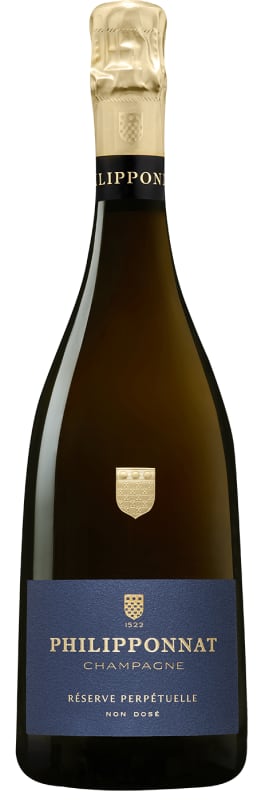


Winemaker Notes
Pale gold in color. Delicate, lingering froth. Aromas of linden, vine blossom and hawthorn. The attack is bold and pure, with notes of citrus fruit and great liveliness without aggressiveness. The finish is long and clear with notes of warm bread and fresh apple.
Ideal as an aperitif and enhances raw fish and seafood. An ideal complement to Japanese cuisine.
*The label for Philipponnat Réserve Perpétuelle Non Dosé is in the process of changing. You may receive either of these two labels featured above. Specific labels cannot be requested.
Professional Ratings
-
James Suckling
Intense on the nose with a kind of bread, butter and strawberry-tartine character, as well as lemon-zest freshness. Firm palate and acidity, with medium to full body and a tight yet elegant finish. 67% pinot noir, 31% chardonnay and 2% pinot meunier. Powerful and austere enough for aging, yet you can enjoy the complexity now.
-
Wine Enthusiast
Although it is described as non dosé, bone dry, rich fruits more than compensate. The result is a ripe Champagne, with an intense floral aroma and tangy, mineral and tight citrus fruits.
-
Wine Spectator
Chalky, chiseled and finely balanced, with a raw silk feel to the mousse. A streak of salinity underscores dried white cherry and raspberry fruit,with notes of lemon pith, almond and white blossoms. Pinot Noir, Chardonnay and Pinot Meunier.
-
Jeb Dunnuck
Also a bright silver straw color, the NV Champagne Reserve Perpetuelle Non Dose has a more focused and powdery nose but otherwise is similar to the Perpetuelle Brut, the only difference being the dosage. For me, its citrus and the more stone fruit notes of white peach stand out, with zesty freshness and powdery chalky earth. Medium-bodied, it has more verticality, and the mousse is more focused and lively compared to the roundness of the Brut.
-
Robert Parker's Wine Advocate
A blend of 65% Pinot Noir, 32% Chardonnay and 3% Pinot Meunier, the NV Royale Réserve Non Dosé offers up aromas of white flowers, jasmine, menthol, iodine and crisp apple mingled with delicate notes of curry leaf. Medium to full-bodied, tense and fresh, it's textured with bright acids and a chalky, mouthwatering finish. Based on the 2020 vintage, it include 34% vins de réserve.


A term typically reserved for Champagne and Sparkling Wines, non-vintage or simply “NV” on a label indicates a blend of finished wines from different vintages (years of harvest). To make non-vintage Champagne, typically the current year’s harvest (in other words, the current vintage) forms the base of the blend. Finished wines from previous years, called “vins de reserve” are blended in at approximately 10-50% of the total volume in order to achieve the flavor, complexity, body and acidity for the desired house style. A tiny proportion of Champagnes are made from a single vintage.
There are also some very large production still wines that may not claim one particular vintage. This would be at the discretion of the winemaker’s goals for character of the final wine.

Associated with luxury, celebration, and romance, the region, Champagne, is home to the world’s most prized sparkling wine. In order to bear the label, ‘Champagne’, a sparkling wine must originate from this northeastern region of France—called Champagne—and adhere to strict quality standards. Made up of the three towns Reims, Épernay, and Aÿ, it was here that the traditional method of sparkling wine production was both invented and perfected, birthing a winemaking technique as well as a flavor profile that is now emulated worldwide.
Well-drained, limestone and chalky soil defines much of the region, which lend a mineral component to its wines. Champagne’s cold, continental climate promotes ample acidity in its grapes but weather differences from year to year can create significant variation between vintages. While vintage Champagnes are produced in exceptional years, non-vintage cuvées are produced annually from a blend of several years in order to produce Champagnes that maintain a consistent house style.
With nearly negligible exceptions, . These can be blended together or bottled as individual varietal Champagnes, depending on the final style of wine desired. Chardonnay, the only white variety, contributes freshness, elegance, lively acidity and notes of citrus, orchard fruit and white flowers. Pinot Noir and its relative Pinot Meunier, provide the backbone to many blends, adding structure, body and supple red fruit flavors. Wines with a large proportion of Pinot Meunier will be ready to drink earlier, while Pinot Noir contributes to longevity. Whether it is white or rosé, most Champagne is made from a blend of red and white grapes—and uniquely, rosé is often produce by blending together red and white wine. A Champagne made exclusively from Chardonnay will be labeled as ‘blanc de blancs,’ while ones comprised of only red grapes are called ‘blanc de noirs.’