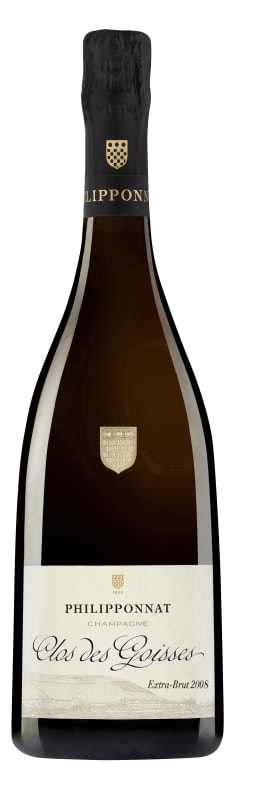


Winemaker Notes
Bright gold with fine and delicate froth. An overall elegant wine. The first nose is floral with notes of linden tea, followed by toasted notes of cacao, blond tobacco and vanilla. A very full structure calling to mind candied white fruit. It is elegant on the palate, with good minerality, toasted and smoked notes, and lingering aromatic persistence. Clos des Goisses is a very fine wine before being a very fine champagne. A perfect and unforgettable match for strong-flavored dishes such as game,truffles, caviar and soft cheeses. It should be decanted into a carafe before being served to allow it to breath.
Professional Ratings
-
Decanter
Shimmering pale gold with green flecks. The slight majority of Chardonnay is a fine decision, as unlike a lot of '08s, the wine is already a pleasure to drink - but it will continue to live a long and distinguished life. Terrific expression of a complex range of citrus scents, confit of lemon and a touch of bergamot. The palate is stunning, with a promise of burgeoning flavours into the 2030s. The fruit is ideally, subtly ripe in classic cooler conditions, but also mineral-stamped in the Clos' tradition. The 2008 has everything - a true great.
-
Robert Parker's Wine Advocate
Comprising 45% Pinot Noir and 55% Chardonnay and disgorged in March 2018 with a dosage of 4.5 grams per liter, Philipponnat’s 2008 Clos des Goisses marks the last vintage in which this cuvée was Chardonnay-dominant. With approximately 75% of the wine vinified in oak, it opens in the glass with an aromatic profile of crisp pear, brioche and baking spices, interwoven with hints of spring flowers and stone fruit. On the palate, it is medium- to full-bodied and tightly wound, with a mid-palate defined by electric acidity and a taut, tensile core, concluding with a long lemon-inflected finish. With its chiseled and incisive character, it presents a striking stylistic counterpoint to the more voluptuous 2009. Despite its pronounced, bracing acidity, the fruit has held up very well, maintaining harmony. This remains a profoundly youthful Champagne; those seeking immediate charm and generosity.
-
Wine & Spirits
The Clos des Goisses is a 13.6-acre parcel on a chalk hillside in Mareuil-sur-Aÿ, a steep, 45-degree slope facing due south, planted to chardonnay (55 percent) and pinot noir. A majority of the wine ferments in oak casks and none of it undergoes malolactic fermentation. The direct southerly exposure and the steep slope provided an ideal situation in a cool, rainy season like 2008, creating a wine with facets and dimensions that continue to shift and evolve through a nuanced finish. The fruit feels completely ripe, and the minimal dosage only serves to accelerate the cool, gingery clarity of flavor. Panelist Jamal Rayyis described the remarkable length of flavor as “turmeric, dried spice, dried apple and chalkiness,” and suggested taking it to dinner at a Thai place for fish in a coconut curry. (Disgorged 9/17.)
-
Wine Spectator
Refined and seamless, showing effortless integration of the chalk-tinged minerality, sleek acidity, and the flavors of poached apple, pastry dough, orchard blossom, ground ginger and graphite carried on a delicate mousse. Drink now through 2035.



The Philipponnat family have been growing grapes in Champagne since 1522. The House was founded in 1910 by Pierre Philipponnat. Charles Philipponnat took over as CEO in 1999 and has improved the quality and production vastly by implementing smaller oak barrels, keeping different vineyard plots separate and utilizing only the first press. The jewel in the crown of the House is the historic and iconic 5.5 hectares 'Clos des Goisses' vineyard that sits on a steep, south-facing 45° slope starting at the Marne River. This is one of the warmest vineyard sites in all of Champagne and is planted to Pinot Noir and Chardonnay. In 1935 'Clos des Goisses' was the first single vineyard Champagne produced and it would take over 50 years for other Houses to start producing serious Champagne just from a single Clos.
Philipponnat applies natural methods to work the soil, hoeing by hand and plowing with horses. The House's expertise is particularly apparent in its use of the solera process. This technique is a very longstanding House tradition; it consists of keeping reserve wines in oak barrels and including them in non-vintage blends (in a proportion of one quarter to one third) and using this blend as a reserve wine for the following blend.
This progressive dilution allows every bottle to retain a trace of previous years' wines blended since the very beginning. Successive Cellar Masters have attached great importance to handing down this expertise. Philipponnat was the first Champagne House to indicate the main year used in its non-vintage blends, the dosage, and the date of disgorgement on back labels, informing consumers and wine experts of the characteristics of each cuvée.

Representing the topmost expression of a Champagne house, a vintage Champagne is one made from the produce of a single, superior harvest year. Vintage Champagnes account for a mere 5% of total Champagne production and are produced about three times in a decade. Champagne is typically made as a blend of multiple years in order to preserve the house style; these will have non-vintage, or simply, NV on the label. The term, "vintage," as it applies to all wine, simply means a single harvest year.

Associated with luxury, celebration, and romance, the region, Champagne, is home to the world’s most prized sparkling wine. In order to bear the label, ‘Champagne’, a sparkling wine must originate from this northeastern region of France—called Champagne—and adhere to strict quality standards. Made up of the three towns Reims, Épernay, and Aÿ, it was here that the traditional method of sparkling wine production was both invented and perfected, birthing a winemaking technique as well as a flavor profile that is now emulated worldwide.
Well-drained, limestone and chalky soil defines much of the region, which lend a mineral component to its wines. Champagne’s cold, continental climate promotes ample acidity in its grapes but weather differences from year to year can create significant variation between vintages. While vintage Champagnes are produced in exceptional years, non-vintage cuvées are produced annually from a blend of several years in order to produce Champagnes that maintain a consistent house style.
With nearly negligible exceptions, . These can be blended together or bottled as individual varietal Champagnes, depending on the final style of wine desired. Chardonnay, the only white variety, contributes freshness, elegance, lively acidity and notes of citrus, orchard fruit and white flowers. Pinot Noir and its relative Pinot Meunier, provide the backbone to many blends, adding structure, body and supple red fruit flavors. Wines with a large proportion of Pinot Meunier will be ready to drink earlier, while Pinot Noir contributes to longevity. Whether it is white or rosé, most Champagne is made from a blend of red and white grapes—and uniquely, rosé is often produce by blending together red and white wine. A Champagne made exclusively from Chardonnay will be labeled as ‘blanc de blancs,’ while ones comprised of only red grapes are called ‘blanc de noirs.’