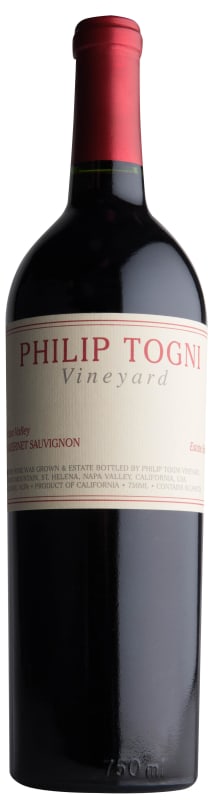


Winemaker Notes
Blend: 82% Cabernet Sauvignon, 15% Merlot, 2% Cabernet Franc
Professional Ratings
-
Decanter
Leads with beautiful capsicum notes and fresh, minted black fruit. Very black. It’s very lively, with excellent acidity and a wonderful mineral freshness. Super fine tannins are just ripe and right now showing nicely. Tasted with Lisa and Philip Togni in their winery atop Spring Mountain. Lisa explained that this wine would see one more racking before bottling, but it had all the natural proportions of the free run and press juice when I tasted it, and wow, what a youthful barrel sample. It's a real standout of the vintage, showing a rich, ruby-purple hue, which is a great sign given the challenges of the heat spike that rocked the valley beginning 31 August. But at 2,000-feet of elevation, the temperature on the valley floor in St. Helena below was 5°C hotter than at the estate. Harvesting began on 23 August and finished around 12 September, and the Tognis felt the law of averages made a difference for them. The slightly underripe fruit picked in late September blended with the riper fruit picked post-heat wave has melded together to create a fantastically approachable Togni! This will be an exciting wine to re-taste once it has gone through that final racking, is bottled, and can settle for a bit. I will re-taste in 2025.
Barrel Sample: 95 -
Robert Parker's Wine Advocate
Philip Togni's 2022 Cabernet Sauvignon Estate is another impressive effort from this 10-acre vineyard high on Spring Mountain. It's medium- to full-bodied, weighing in at just 13.8% alcohol, but delivers masses of ripe black cherries. Richly concentrated and dense, it's balanced by bright acids, while hints of mocha and fresh raspberries mingle easily on the long, tannic finish. "It's going to be alright," said Togni as we tasted it. "Just give it long enough. Rating: 97+
-
Jeb Dunnuck
Based on 82% Cabernet Sauvignon, 15% Merlot, 2% Cabernet Franc, and the rest Petit Verdot and aged 20 months in 40% new French oak, the 2022 Cabernet Sauvignon reveals a complex perfume of cassis, smoky tobacco, lead pencil, and graphite that gives it a remarkable Saint-Julien-like profile. It's medium to full-bodied on the palate, has a fresh, lively, elegant mouthfeel, ripe tannins, and a great finish. It's easily one of the most successful 2022s in the vintage and is well worth your time and money.
-
Vinous
The 2022 Cabernet Sauvignon Estate is a very pretty, aromatic, fresh mid-weight offering from the Togni family. A wine of grace and understatement, the 2022 is quite restrained. Sweet floral and spice notes meld into a core of red/purplish fruit. All the elements are very nicely balanced. Even so, there is no getting around the fact that this is a lighter vintage.
-
Wine Spectator
Red currant and damson plum fruit shows nice pixelation, especially for 2022, while red tea and iris notes fill in, with a sleek iron hint. Focused, pure and lengthy, with its slightly chalky structure staying nicely embedded in the fruit, giving this a mouthwatering finish. Offers the muted energy of the vintage, but all things considered, this is a clear winner.


A noble variety bestowed with both power and concentration, Cabernet Sauvignon enjoys success all over the globe, its best examples showing potential to age beautifully for decades. Cabernet Sauvignon flourishes in Bordeaux's Medoc where it is often blended with Merlot and smaller amounts of some combination of Cabernet Franc, Malbecand Petit Verdot. In the Napa Valley, ‘Cab’ is responsible for some of the world’s most prestigious, age-worthy and sought-after “cult” wines. Somm Secret—DNA profiling in 1997 revealed that Cabernet Sauvignon was born from a spontaneous crossing of Cabernet Franc and Sauvignon Blanc in 17th century southwest France.

Above the town of St. Helena on the eastern slopes of the Mayacamas Mountains sits the Spring Mountain District.
A dynamic region, its vineyards, cut by numerous springs and streams, vary in elevation, slope and aspect. Soils differ throughout with over 20 distinct types inside of the 8,600 acres that define the appellation. Within that area, only about 1,000 are planted to vineyards. Predominantly farmed by small, independent producers, the region currently has just over 30 wineries.
During the growing season, late afternoon Pacific Ocean breezes reach the Spring Mountain vineyards, which sit at between 400 and 1,200 feet. Daytime temperatures during mid summer and early fall remain slightly cooler than those of the valley floor.
Spring Mountain soils—volcanic matter and sedimentary rock—create intense but balanced reds with lush and delicate tannins. The area excels with Bordeaux varieties such as Cabernet Sauvignon, Cabernet Franc and Merlot and in some cooler spots, Chardonnay.