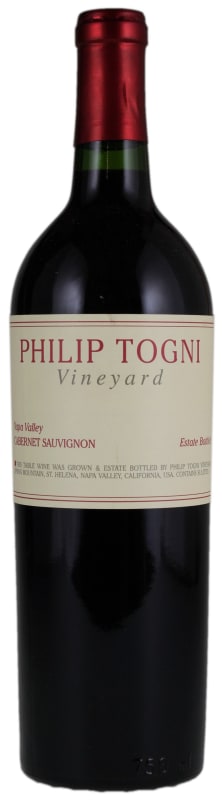


Winemaker Notes
Professional Ratings
-
Decanter
The Togni family's 2014 reveals a beautifully complex bouquet of plum, black cherry, clove, sweet tobacco, cocoa nib and hints of mountain laurel. On the palate the tannins are very silky and refined, especially by the standards of this site, framing a wine with great concentration, depth and acid line. A supremely graceful Cabernet and a worthy successor to the profound 2013.
-
Vinous
The 2014 Cabernet Sauvignon Estate has only recently started to open after a long period of dormancy. It’s classic Togni all the way: dark, intensely savory and built to age. Once a brute, today the 2014 is all understatement, all class. Sage, mint, graphite, dried flowers, blood orange and mocha weave through a core of dark-toned fruit. Despite drought conditions, yields were quite generous at three tons per acre.
-
Robert Parker's Wine Advocate
Togni's 2014 Cabernet Sauvignon Estate, tasted at the winery as the 10-year anniversary release, is just starting to show some maturity, with complex, compelling notes of earth, cassis, mocha, tobacco, cigar box and vanilla. It's medium to full-bodied, somehow both firm and silky in feel, with a ripe, lingering finish. Looking back at Robert Parker's notes from its release, it's fascinating to see that he rated this wine 94+ and considered it "one of his [Togni's] more forward and precociously styled Cabernets." Rating: 94+
-
Wine Spectator
This has the dark fruit and loam edges of a mountain fruit–based wine, with waves of warm cassis and ganache that are expressive and velvety in feel, while menthol, sage and bay leaf notes fill in the background. Grippy yet inviting, with the flavors melding wonderfully through the long finish, where a sense of freshness pervades. Best from 2020 through 2040.


A noble variety bestowed with both power and concentration, Cabernet Sauvignon enjoys success all over the globe, its best examples showing potential to age beautifully for decades. Cabernet Sauvignon flourishes in Bordeaux's Medoc where it is often blended with Merlot and smaller amounts of some combination of Cabernet Franc, Malbecand Petit Verdot. In the Napa Valley, ‘Cab’ is responsible for some of the world’s most prestigious, age-worthy and sought-after “cult” wines. Somm Secret—DNA profiling in 1997 revealed that Cabernet Sauvignon was born from a spontaneous crossing of Cabernet Franc and Sauvignon Blanc in 17th century southwest France.

Above the town of St. Helena on the eastern slopes of the Mayacamas Mountains sits the Spring Mountain District.
A dynamic region, its vineyards, cut by numerous springs and streams, vary in elevation, slope and aspect. Soils differ throughout with over 20 distinct types inside of the 8,600 acres that define the appellation. Within that area, only about 1,000 are planted to vineyards. Predominantly farmed by small, independent producers, the region currently has just over 30 wineries.
During the growing season, late afternoon Pacific Ocean breezes reach the Spring Mountain vineyards, which sit at between 400 and 1,200 feet. Daytime temperatures during mid summer and early fall remain slightly cooler than those of the valley floor.
Spring Mountain soils—volcanic matter and sedimentary rock—create intense but balanced reds with lush and delicate tannins. The area excels with Bordeaux varieties such as Cabernet Sauvignon, Cabernet Franc and Merlot and in some cooler spots, Chardonnay.