


Winemaker Notes
Born in a cooler than usual year, the aromatic complexity and freshness of the 2005 Ornellaia reflect the conditions of the harvest. The delayed harvest allowed us to obtain perfectly ripe tannins that are soft and silky. Deep ruby red in color, it has an elegant, complex bouquet with red and black berry fruit supported by underlying hints of tobacco and spice. On the palate the wine is full and enveloping, displaying a powerful, extremely elegant densely woven tannic structure that flows into a long fruity finish with balsamic overtones.
Professional Ratings
-
James Suckling
An evolved and scented wine with aromas of leather, blueberries, raspberry eau de vie, a touch of coffee grounds and meaty if not gamey depth. Full-bodied with chewy tannins and acidity and a biting palate. It's tight and well balanced.
-
Wine Spectator
Displays beautiful aromas of ripe fruit, with currant, plum and blackberry. Complex and full-bodied, with soft, polished tannins and a long, long finish. This shows a deft hand in the winemaking. Best after 2012.
-
Robert Parker's Wine Advocate
The medium-bodied 2005 Ornellaia shows plenty of delineation in its dark cherries, blueberries, spices, minerals and crushed rocks. The 2005 doesn't have the detail of the 2004 or the richness of the 2006, but it does offer notable finesse and clarity in an understated style for this wine. My impression is that this will be a relatively early-maturing vintage of Ornellaia, which is not a bad thing, considering the age-worthiness of the two vintages which surround it. In 2005 Ornellaia is 60% Cabernet Sauvignon, 22% Merlot, 14% Cabernet Franc and 4% Petit Verdot. It is a big success in this vintage. Anticipated maturity: 2010-2020.


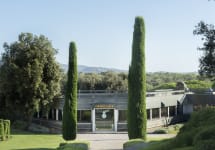
In 1981, Marchese Lodovico Antinori breathed new life into Tenuta dell' Ornellaia, an estate whose potential had been ignored for decades. With the help of Andre Tchelistcheff, the famous agronomist, Antinori planted the first French vines in Bolgheri, which lies in the heart of Tuscany's coastal region, Maremma. The estate yields some of the finest Sangiovese, Cabernet Sauvignon, Merlot, and Cabernet Franc in Tuscany. In 2002, Marchesi de' Frescobaldi and Robert Mondavi became owners of Tenuta dell'Ornellaia, which is now owned exclusively by Marchesi de' Frescobaldi.
Ornellaia has established itself among the iconic wine estates in Italy (and beyond). The estate is dedicated to producing charming and opulent wines, full of Mediterranean character and finesse, reflecting the estate’s unique terroir in Bolgheri on the Tuscan coast. The combination of Bolgheri’s unique soils and growing conditions, and what can only be characterized as a total obsession with excellence, result in the world-class wines from Cabernet Sauvignon, Merlot, and Sauvignon Blanc that so many wine lovers across the world have come to cherish.
Ornellaia employs a full time team of 80 people whose passion and motivation make Ornellaia what it is today. No shortcuts in the part of the production are allowed and the details literally come down to a grape by grape basis. Wines are intently crafted to capture the character of each vintage, in all its complexity and facets. In fact, the character and intricacies of each individual vintage are so important to the estate that since vintage 2006, Winemaker and Estate Director Axel Heinz has identified a single word that captures the character of each vintage, and that word is interpreted by a contemporary artist who produces special labels and a site-specific work of art that remains part of the estate’s permanent collection.
In addition to its place among Italy’s iconic wines, Ornellaia is also an ambassador for the Bolgheri region, leading it to be recognized as one of Italy’s greatest winegrowing regions. It is their belief, and it is hard to argue, that Bogheri’s mild maritime climate and diversity of soils create wines as distinct, complex and pleasurable as any in the world.

One of the world’s most classic and popular styles of red wine, Bordeaux-inspired blends have spread from their homeland in France to nearly every corner of the New World. Typically based on either Cabernet Sauvignon or Merlot and supported by Cabernet Franc, Malbec and Petit Verdot, the best of these are densely hued, fragrant, full of fruit and boast a structure that begs for cellar time. Somm Secret—Blends from Bordeaux are generally earthier compared to those from the New World, which tend to be fruit-dominant.

An outstanding wine region made famous by Marchese Mario Incisa della Rocchetta, who planted Cabernet Sauvignon vines for his own consumption in 1940s on his San Guido estate, and called the resulting wine, Sassicaia. Today the region’s Tuscan reds are based on Cabernet Sauvignon and Merlot, which can be made as single varietal wines or blends. The local Sangiovese can make up no more than 50% of the blends. Today Sassicaia has its own DOC designation within the Bogheri DOC appellation.