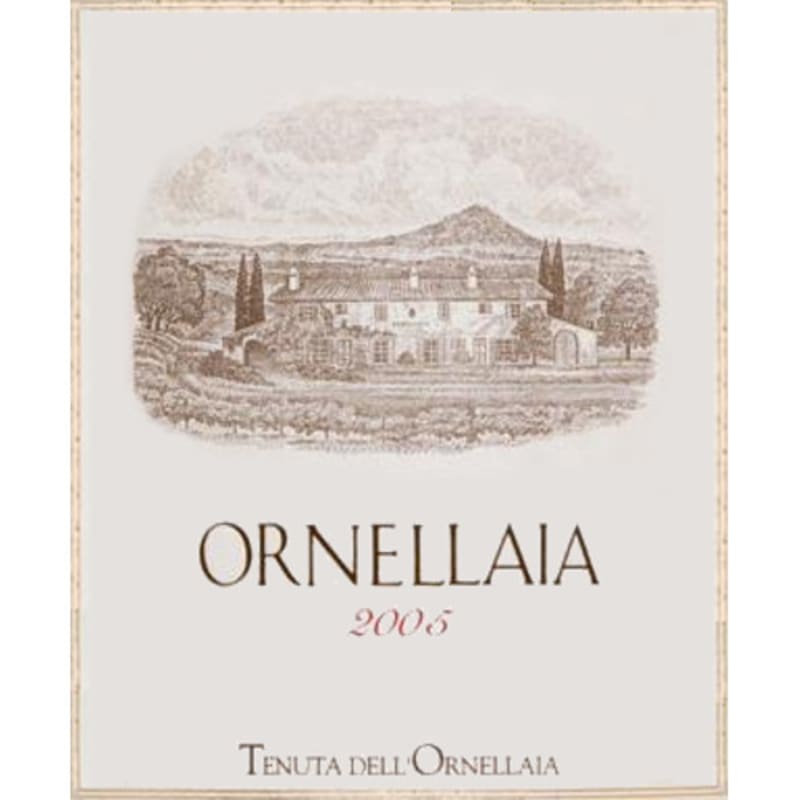

Winemaker Notes
Professional Ratings
-
James Suckling
An evolved and scented wine with aromas of leather, blueberries, raspberry eau de vie, a touch of coffee grounds and meaty if not gamey depth. Full-bodied with chewy tannins and acidity and a biting palate. It's tight and well balanced.
-
Wine Spectator
Displays beautiful aromas of ripe fruit, with currant, plum and blackberry. This complex and full-bodied Tuscan red has soft, polished tannins and a long, long finish. Shows a deft hand in the winemaking. Best after 2012. 11,660 cases made.
-
Robert Parker's Wine Advocate
The medium-bodied 2005 Ornellaia shows plenty of delineation in its dark cherries, blueberries, spices, minerals and crushed rocks. The 2005 doesn’t have the detail of the 2004 or the richness of the 2006, but it does offer notable finesse and clarity in an understated style for this wine. My impression is that this will be a relatively early-maturing vintage of Ornellaia, which is not a bad thing, considering the age-worthiness of the two vintages which surround it. In 2005 Ornellaia is 60% Cabernet Sauvignon, 22% Merlot, 14% Cabernet Franc and 4% Petit Verdot. It is a big success in this vintage. Anticipated maturity: 2010-2020.
-
Wine & Spirits
This feels closed and reticent at first, a muddle of aromas and flavor. It gains definition with air, leading with black cherry and ripe fig flavors backed by savory, slightly herbaceous tannins. Cellar it for eight years and then decant for a grilled ribeye.


One of the world’s most classic and popular styles of red wine, Bordeaux-inspired blends have spread from their homeland in France to nearly every corner of the New World. Typically based on either Cabernet Sauvignon or Merlot and supported by Cabernet Franc, Malbec and Petit Verdot, the best of these are densely hued, fragrant, full of fruit and boast a structure that begs for cellar time. Somm Secret—Blends from Bordeaux are generally earthier compared to those from the New World, which tend to be fruit-dominant.

An outstanding wine region made famous by Marchese Mario Incisa della Rocchetta, who planted Cabernet Sauvignon vines for his own consumption in 1940s on his San Guido estate, and called the resulting wine, Sassicaia. Today the region’s Tuscan reds are based on Cabernet Sauvignon and Merlot, which can be made as single varietal wines or blends. The local Sangiovese can make up no more than 50% of the blends. Today Sassicaia has its own DOC designation within the Bogheri DOC appellation.