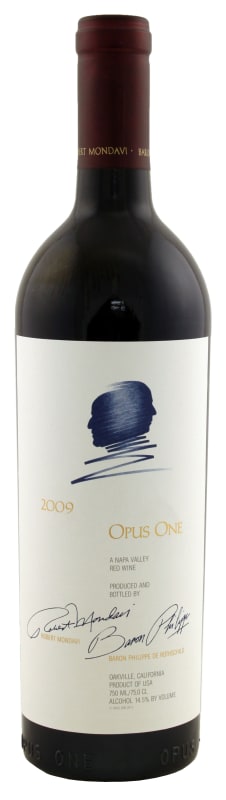


Winemaker Notes
Blend: 81% Cabernet Sauvignon, 9% Cabernet Franc, 6% Petit Verdot, 3% Merlot, 1% Malbec
Professional Ratings
-
Wine Spectator
This is still quite youthful, with succulence to its ample core of black cherry and black currant fruit. There’s a tarry edge that gives drive, but also freshness in the form of tobacco, savory and sage notes. On the finish the fruit is still thumping with energy and focus. Cabernet Sauvignon, Cabernet Franc, Petit Verdot, Merlot and Malbec.
-
Decanter
2009 was a cooler vintage, and that's reflected in the complex bass notes of black olive and tobacco which inflect this Opus One's bouquet of dark fruit, chocolate and licorice; supple and polished on the palate, this wine has more of a savoury edge to its tannic profile than riper years such as 2007. Cabernet Sauvignon only makes up 81% of the blend here, complemented by fully 9% Cabernet Franc, a variety that plays an increasing role at Opus.
-
Jeb Dunnuck
Along the same lines as the 2008, the 2009 Opus One is balanced and elegant, with a mature feel in its darker fruits as well as herbal, coffee, and chocolaty nuances. In general, most 2009s are drinking nicely today, and this certainly seems to be right in the middle of its prime drink window.
-
James Suckling
Aromas of orange peel, currants, olives and subtle rosemary. Full body with a beautiful balance of fine tannins and a fresh finish. Super-refined and beautiful.


Undoubtedly proving its merit over and over, Napa Valley is a now a leading force in the world of prestigious red wine regions. Though Cabernet Sauvignon dominates Napa Valley, other red varieties certainly thrive here. Important but often overlooked include Merlot and other Bordeaux varieties well-regarded on their own as well as for their blending capacities. Very old vine Zinfandel represents an important historical stronghold for the region and Pinot noir is produced in the cooler southern parts, close to the San Pablo Bay.
Perfectly situated running north to south, the valley acts as a corridor, pulling cool, moist air up from the San Pablo Bay in the evenings during the hot days of the growing season, which leads to even and slow grape ripening. Furthermore the valley claims over 100 soil variations including layers of volcanic, gravel, sand and silt—a combination excellent for world-class red wine production.