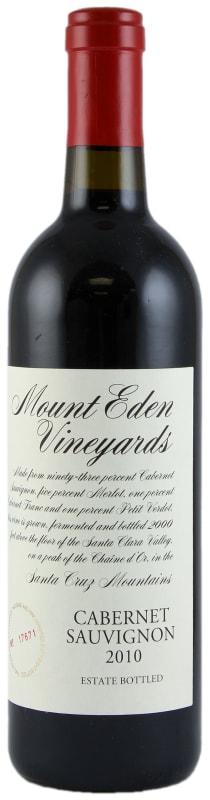


Winemaker Notes
The hallmark and beauty of this year is transparency of the fruit and abundant complexity. Black fruit, incense and sweet spices in the nose, with silky tannins and an endless array of violet, sage, espresso and grilled herbs on the palate, this Cabernet has exceptional overall balance and personality with an elegance that reminds one of a bygone era.
Professional Ratings
-
Wine & Spirits
Most of the fruit for this restrained, savory cabernet comes from cuttings Emmett Rixford purportedly sourced from Château Margaux in the 1890s. Martin Ray propagated his own cuttings from that selection to plant in this vineyard’s shallow, shale-laced soils at 1,800 feet of elevation in the 1940s and 50s, and later Jeffrey Patterson replanted it in the 1980s with a selection from those vines. Is it just a coincidence that, tasting this blind, my thoughts turned to a 1985 Margaux I tasted recently? Maybe it was the gentle elasticity of the texture, the vibrant acidity, the rosy glow streaming through a curtain of ripe, earthy tannins. This feels layered with complexity: Beyond the pure cassis tone you might find lavender, graphite, redwood bark, black olive and green herbs. But you don’t need to go fishing for descriptors to appreciate its nuances: just think of it as lovely, integrated, old-school California cabernet. Buy a case and try not to drink most of it until 2030.
-
Robert Parker's Wine Advocate
The most elegant and poised rendition of this wine in the modern era, the 2010 Cabernet Sauvignon Estate has aged gracefully thus far. The nose shows a pretty and floral side of Cabernet, melded with a smoky, smoldering undertone of complexity. Pleasant, understated tannins meld beautifully with a soft, precise and lively acidity. This wine can easily be overlooked in a lineup of showstopper vintages but offers a refreshing counterpoint that emphasizes the versatility of Mount Eden.


A noble variety bestowed with both power and concentration, Cabernet Sauvignon enjoys success all over the globe, its best examples showing potential to age beautifully for decades. Cabernet Sauvignon flourishes in Bordeaux's Medoc where it is often blended with Merlot and smaller amounts of some combination of Cabernet Franc, Malbecand Petit Verdot. In the Napa Valley, ‘Cab’ is responsible for some of the world’s most prestigious, age-worthy and sought-after “cult” wines. Somm Secret—DNA profiling in 1997 revealed that Cabernet Sauvignon was born from a spontaneous crossing of Cabernet Franc and Sauvignon Blanc in 17th century southwest France.

A rugged and topographically diverse cool-climate appellation with a rich history, the Santa Cruz Mountains AVA stretches from Half Moon Bay, just south of San Francisco, to the northern border of Monterey County. Elevations range from 800 feet to upwards of 3,000 and microclimates vary substantially depending on which side of the mountains the vineyards lie; cool ocean winds and fog play an important role here. This can be a challenging region in which to grow grapes, but it is well worth the effort. Santa Cruz Mountains wines are noted for balanced acidity levels, often showing great aging potential. Wine has been made here since the 1800s, most notably from the legendary Ridge Vineyards, whose Monte Bello vineyard garners international admiration.
Pinot Noir, Chardonnay and Cabernet Sauvignon are the stars of this region, while Merlot and Zinfandel also perform quite well. Organic and sustainable vineyard practices are becoming increasingly common.