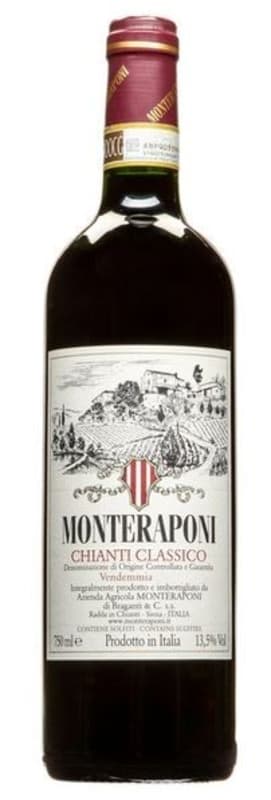


Winemaker Notes
Crystal-clear, pale red-colored. The nose offers intense notes of violet, green pepper and raspberry. The strong minerality on the palate blends wonderfully with the freshness given by the calcareous, stony and marly soil. Long-lasting, full bodied and structured, but enjoyable and not overwhelming on the palate, owing to the silky and soft tannins that bring out the wine’s elegance.
Professional Ratings
-
Robert Parker's Wine Advocate
The organic Monteraponi 2022 Chianti Classico is a real straight-shooter, delivering lots of bright primary fruit and good intensity. The bouquet reflects the slightly cooler Radda subzone with tart berry flavors and pronounced floral aromas, especially blue bells and violets. The wine feels fresh and easy on the palate.
-
Vinous
The 2022 Chianti Classico is a powerful, rich wine that offers a striking reflection of the intensity of the year, slightly tempered by the elevation of Radda. Crushed flowers, red berry fruit, cinnamon and orange peel are all nicely lifted. There's gorgeous brilliance and energy here.


Among Italy's elite red grape varieties, Sangiovese has the perfect intersection of bright red fruit and savory earthiness and is responsible for the best red wines of Tuscany. While it is best known as the chief component of Chianti, it is also the main grape in Vino Nobile di Montepulciano and reaches the height of its power and intensity in the complex, long-lived Brunello di Montalcino. Somm Secret—Sangiovese doubles under the alias, Nielluccio, on the French island of Corsica where it produces distinctly floral and refreshing reds and rosés.

Famous for its food-friendly, approachable red wines and their storied history, Chianti is perhaps the best-known wine region of Italy. This appellation within Tuscany has it all: sweeping views of rolling hills, endless vineyards, the warm Mediterranean sun, hearty cuisine and a rich artistic heritage. Chianti includes seven subzones: Chianti Colli Fiorentini, Rufina, Montalbano, Colli Senesi, Colline Pisane, Colli Aretini and Montespertoli, with area beyond whose wines can be labeled simply as Chianti.
However the best quality comes from Chianti Classico, in the heart of the Chianti zone, which is no longer a subzone of the region at all but has been recognized on its own since 1996. The Classico region today is delimited by the confines of the original Chianti zone protected since the 1700s.
Chianti wines are made primarily of Sangiovese, with other varieties comprising up to 25-30% of the blend. Generally, local varieties are used, including Canaiolo, Colorino and Mammolo, but international varieties such as Cabernet Sauvignon, Merlot and Syrah are allowed as long as they are grown within the same zone.
Basic, value-driven Chianti wine is simple and fruit-forward and makes a great companion to any casual dinner. At its apex, Chianti is full bodied but with good acidity, firm tannins, and notes of tart red fruit, dried herbs, fennel, balsamic and tobacco. Chianti Riserva, typically the top bottling of a producer, can benefit handsomely from a decade or two of cellaring.