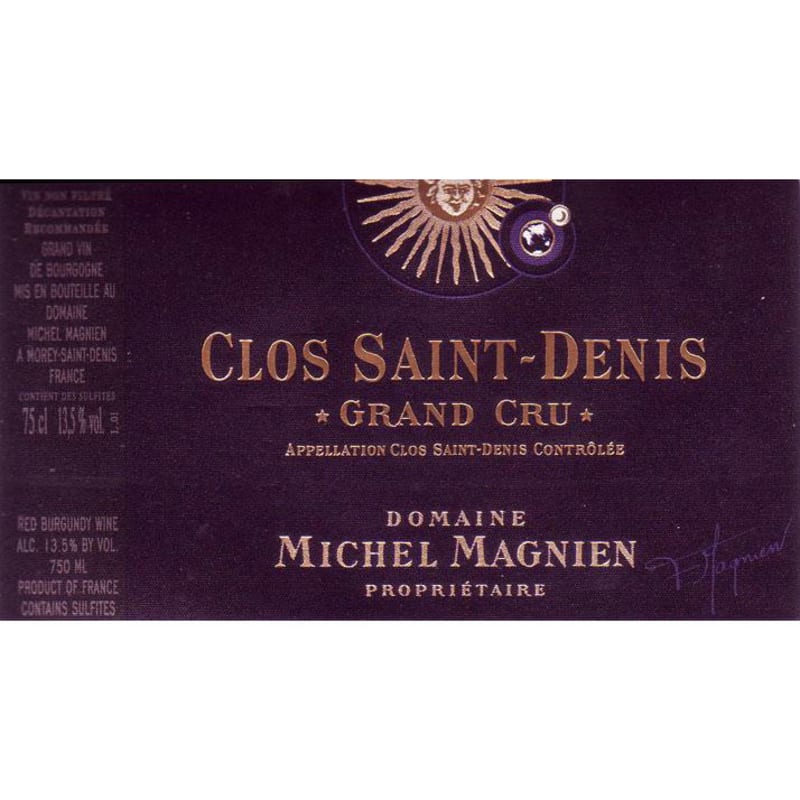

Winemaker Notes
The vineyards are adjacent to "Clos de la Roche" and planted on a clay-limestone soil with a mixture of iron oxide. The "Clos Saint-Denis" is the most delicate wine of the village of Morey-Saint-Denis; it relies on a mixture of clay and brown limestone pebbles which gives it this charming and fine character.
Despite its proximity to Clos de la Roche, Clos-Saint-Denis tends to be more like a wine from Chambolle-Musigny with a pretty fragrance of red fruits and flowers and a supple texture on the palate. While it typically shows finesse, a great Clos-Saint-Denis should have a great intensity of flavor and length.
This Grand Cru accompanies perfectly a roast duck breast with foie gras.
Professional Ratings
-
Robert Parker's Wine Advocate
The stunning 1999 Clos St.-Denis has a dark ruby, almost black, saturated color. Leather, licorice, and blackberry syrup can be found in its boisterous aromatics. This full-bodied, chewy-textured wine has a magnificent breadth of black fruits, cherries, blueberries, and spices in its dense character. It is satin-textured, thick, powerful, and seamless.


Thin-skinned, finicky and temperamental, Pinot Noir is also one of the most rewarding grapes to grow and remains a labor of love for some of the greatest vignerons in Burgundy. Fairly adaptable but highly reflective of the environment in which it is grown, Pinot Noir prefers a cool climate and requires low yields to achieve high quality. Outside of France, outstanding examples come from in Oregon, California and throughout specific locations in wine-producing world. Somm Secret—André Tchelistcheff, California’s most influential post-Prohibition winemaker decidedly stayed away from the grape, claiming “God made Cabernet. The Devil made Pinot Noir.”

While Morey-St-Denis of Burgundy might not get the same attention as its neighbors, Gevrey-Chambertin to the north and Chambolle-Musigny to the south, there is no reason why it shouldn’t. The same line of limestone runs from the Combe de Lavaux in Gevrey—all the way through Morey—ending in Chambolle.
There are four grand cru vineyards, moving southwards from the border with Gevrey-Chambertin: Clos de la Roche, Clos St-Denis, Clos des Lambrays, Clos de Tart and a small segment of Bonnes-Mares overlapping from Chambolle. Clos de la Roche is probably the finest vineyard, giving wines of true depth, body, and sturdiness for the long haul than most other vineyards.
Pinot Noir from Morey-St-Denis is known for its deep red cherry, blackcurrant and blueberry fruit. Aromas of spice, licorice and purple flowers are present in the wines’ youth, evolving to forest and game as the wine ages.