
Winemaker Notes
Professional Ratings


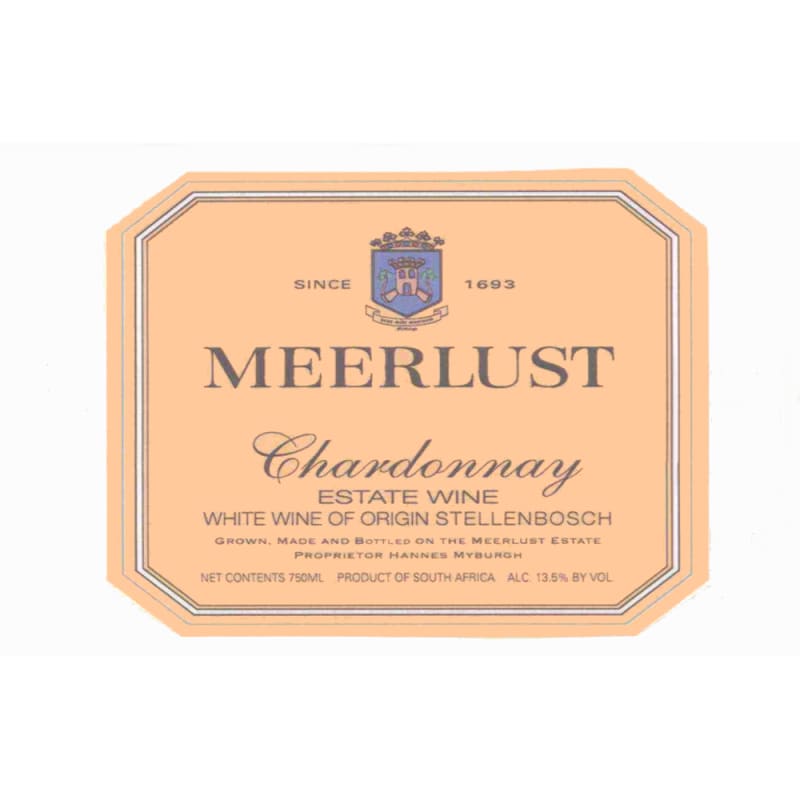
Meerlust is one of South Africa's most famous and historical wine estates. The land where the farm is now situated was originally owned by a powerful and wealthy free burgher named Henning Huising. After his death in 1713 the estate passed through many hands until it was bought in 1756 by Johannes Albertus Myburgh - and has remained in the Myburgh family ever since.
Nicholaas Myburgh (7th generation of the Myburgh family, and father of present owner Hannes Myburgh) took over the farm in 1950, but the condition of the property had declined severely from its 18th century splendor. Nicolaas set about an extensive restoration of both the buildings and the vineyards. One of his first projects was the construction of a damn that allows for irrigation in exceptionally dry years, but is usually used only after the vintage. He also replanted the vineyards with mainly red varietals.
The farm is approximately 15 kilometers outside Stellenbosch, and is the Stellenbosch estate nearest the Indian Ocean (the name Meerlust is of German origin, and translates to "pleasure of the sea"). The cooling breezes off False Bay allow a slower, steadier ripening period for the grapes. This translates to less loss of fruit aromas, and there is also a lesser risk of a crop being ruined in the event of a sudden, dramatic rise in temperature.

One of the most popular and versatile white wine grapes, Chardonnay offers a wide range of flavors and styles depending on where it is grown and how it is made. While it tends to flourish in most environments, Chardonnay from its Burgundian homeland produces some of the most remarkable and longest lived examples. California produces both oaky, buttery styles and leaner, European-inspired wines. Somm Secret—The Burgundian subregion of Chablis, while typically using older oak barrels, produces a bright style similar to the unoaked style. Anyone who doesn't like oaky Chardonnay would likely enjoy Chablis.

With an important wine renaissance in full swing, impressive red and white bargains abound in South Africa. The country has a particularly long and rich history with winemaking, especially considering its status as part of the “New World.” In the mid-17th century, the lusciously sweet dessert wines of Constantia were highly prized by the European aristocracy. Since then, the South African wine industry has experienced some setbacks due to the phylloxera infestation of the late 1800s and political difficulties throughout the following century.
Today, however, South Africa is increasingly responsible for high-demand, high-quality wines—a blessing to put the country back on the international wine map. Wine production is mainly situated around Cape Town, where the climate is generally warm to hot. But the Benguela Current from Antarctica provides brisk ocean breezes necessary for steady ripening of grapes. Similarly, cooler, high-elevation vineyard sites throughout South Africa offer similar, favorable growing conditions.
South Africa’s wine zones are divided into region, then smaller districts and finally wards, but the country’s wine styles are differentiated more by grape variety than by region. Pinotage, a cross between Pinot Noir and Cinsault, is the country’s “signature” grape, responsible for red-fruit-driven, spicy, earthy reds. When Pinotage is blended with other red varieties, like Cabernet Sauvignon, Merlot, Syrah or Pinot Noir (all commonly vinified alone as well), it is often labeled as a “Cape Blend.” Chenin Blanc (locally known as “Steen”) dominates white wine production, with Chardonnay and Sauvignon Blanc following close behind.