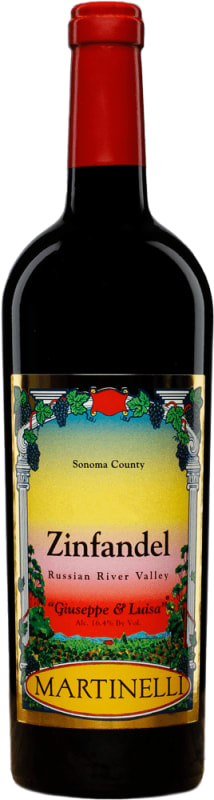


Winemaker Notes
The wine opens with inviting aromas of ripe black cherry and Santa Rosa plum, intertwined with subtle, warming spices that evoke a sense of comfort. A lively, bright entry flows seamlessly into a well-balanced mid-palate, where vibrant cherry tart and succulent plum notes take center stage. The wine's harmonious structure persists across the entire palate, culminating in a mouthwatering finish accented by delicate hints of lingering milk chocolate shavings.
Professional Ratings
-
Jeb Dunnuck
A saturated ruby red color, the 2023 Zinfandel Giuseppe & Luisa is savory and has an intriguing nose with notes of cedar, red berries, and baked earth. The acidity is incredible on this wine, which has a salty feel and bright, shining fruit. This is a great value.
-
Wine Spectator
Plump and jammy yet well-sculpted, this Zin offers rich and generous flavors of black cherry and raspberry laced with bittersweet mocha, savory pepper and anise notes as this builds polish toward plush tannins. Drink now through 2033. 1,500 cases made.
-
Robert Parker's Wine Advocate
From vines planted in 1995, the 2023 Zinfandel Giuseppe & Luisa was matured in 40% new French oak. It has open, inviting aromas of cranberry, blueberry, wildflowers, earth and spice. The medium-bodied palate features generous, spicy flavors framed by grainy tannins. It’s balanced by mouthwatering acidity and has a long, flavorful finish.


Unapologetically bold, spice-driven and jammy, Zinfandel has secured its title as the darling of California vintners by adapting well to the state's diverse microclimates and landscapes. Born in Croatia, it later made its way to southern Italy where it was named Primitivo. Fortunately, the imperial nursery of Vienna catalogued specimens of the vine, and it later made its way to New England in 1829. Parading the true American spirit, Zinfandel found a new home in California during the Gold Rush of 1849. Somm Secret—California's ancient vines of Zinfandel are those that survived the neglect of Prohibition; today these vines produce the most concentrated, ethereal and complex examples.

A standout region for its decidedly Californian take on Burgundian varieties, the Russian River Valley is named for the eponymous river that flows through it. While there are warm pockets of the AVA, it is mostly a cool-climate growing region thanks to breezes and fog from the nearby Pacific Ocean.
Chardonnay and Pinot Noir reign supreme in Russian River, with the best examples demonstrating a unique combination of richness and restraint. The cool weather makes Russian River an ideal AVA for sparkling wine production, utilizing the aforementioned varieties. Zinfandel also performs exceptionally well here. Within the Russian River Valley lie the smaller appellations of Chalk Hill and Green Valley. The former, farther from the ocean, is relatively warm, with a focus on red and white Bordeaux varieties. The latter is the coolest, foggiest parcel of the Russian River Valley and is responsible for outstanding Pinot Noir and Chardonnay.