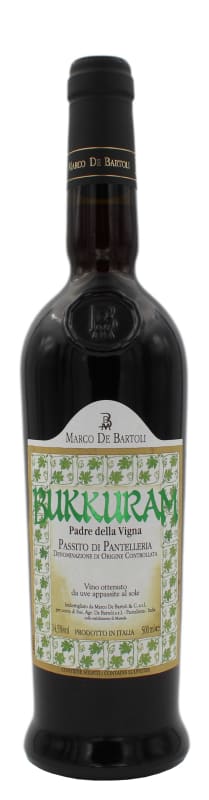


Winemaker Notes
100% Zibibbo. Mainly from 35-50-year-old, bush-trained vines, grown very low to the ground on very light, sandy, brown, volcanic soils in the walled and windy clos of the De Bartoli’s small Bukkuram estate on the island of Pantelleria. Two dried-grape passito wines, Sole di Agosto and Padre della Vigna, come from this vineyard, which is organically farmed and harvested by hand. The harvest takes place in two stages. The first is in mid-August—in a normal vintage, these bunches are dried on mats in the sun for two weeks. The second harvest is several weeks later. This riper fruit is direct-pressed and spontaneously fermented; the sun-dried bunches are then destemmed and added to the fresh wine for a three-month maceration. That wine is aged for six months in oak barrels and released as “Sole di Agosto” or “Sun of August”, a light, fresh style of sweet wine of around 180 grams/liter of residual sugar. In very special vintages, De Bartoli makes the rare “Padre della Vigna” (”Father of the Vineyard”) instead: the first-harvest fruit is dried in the sun for a minimum of four weeks before being added to the young base wine for three months of maceration. This wine is aged for a minimum of three years, and often much longer, in barrel. It usually comes in around 200 grams/liter RS and is a much more complex expression of Zibibbo. Generally speaking, only one or the other of the two passitos is made in a vintage.
Professional Ratings
-
Vinous
Roasted hazelnuts come together with spiced orange peel, cedar shavings and worn leather as the 2019 Bukkuram Padre Della Vigna blossoms in the glass. It's silky-smooth, nearly glycerol in feel, with a core of brilliant acidity to balance. Sweet spices give way to peach nectar and hints of brown spice in the mouth. It leaves the palate reeling with a salty saturation of minerality, cleaning up remarkably well with slowly tapering notes of dark chocolate.


Apart from the classics, we find many regional gems of different styles.
Late harvest wines are probably the easiest to understand. Grapes are picked so late that the sugars build up and residual sugar remains after the fermentation process. Ice wine, a style founded in Germany and there referred to as eiswein, is an extreme late harvest wine, produced from grapes frozen on the vine, and pressed while still frozen, resulting in a higher concentration of sugar. It is becoming a specialty of Canada as well, where it takes on the English name of ice wine.
Vin Santo, literally “holy wine,” is a Tuscan sweet wine made from drying the local white grapes Trebbiano Toscano and Malvasia in the winery and not pressing until somewhere between November and March.
Rutherglen is an historic wine region in northeast Victoria, Australia, famous for its fortified Topaque and Muscat with complex tawny characteristics.

A large, geographically and climatically diverse island, just off the toe of Italy, Sicily has long been recognized for its fortified Marsala wines. But it is also a wonderful source of diverse, high quality red and white wines. Steadily increasing in popularity over the past few decades, Italy’s fourth largest wine-producing region is finally receiving the accolades it deserves and shining in today's global market.
Though most think of the climate here as simply hot and dry, variations on this sun-drenched island range from cool Mediterranean along the coastlines to more extreme in its inland zones. Of particular note are the various microclimates of Europe's largest volcano, Mount Etna, where vineyards grow on drastically steep hillsides and varying aspects to the Ionian Sea. The more noteworthy red and white Sicilian wines that come from the volcanic soils of Mount Etna include Nerello Mascalese and Nerello Cappuccio (reds) and Carricante (whites). All share a racy streak of minerality and, at their best, bear resemblance to their respective red and white Burgundies.
Nero d’Avola is the most widely planted red variety, and is great either as single varietal bottling or in blends with other indigenous varieties or even with international ones. For example, Nero d'Avola is blended with the lighter and floral, Frappato grape, to create the elegant, Cerasuolo di Vittoria, one of the more traditional and respected Sicilian wines of the island.
Grillo and Inzolia, the grapes of Marsala, are also used to produce aromatic, crisp dry Sicilian white. Pantelleria, a subtropical island belonging to the province of Sicily, specializes in Moscato di Pantelleria, made from the variety locally known as Zibibbo.