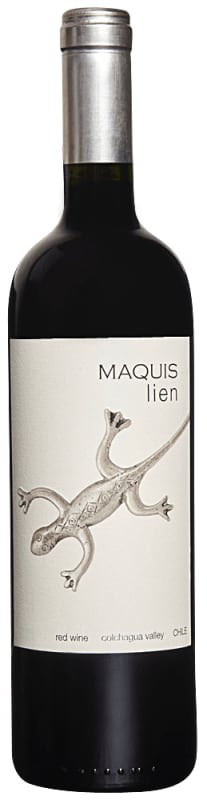


Winemaker Notes
Maquis Lien 2017 has a beautiful bright red color. Its aromas include berries and freshly ripe plums on a delicate floral background such as sage and rosemary with pronounced notes of black tobacco. The mouth is very fresh and vibrant, where its elegant structure relies mainly on its delicate tannins, but at the same time intense. The finish is long and deep marked by a very special minerality.
Professional Ratings
-
Robert Parker's Wine Advocate
I found subtle aromas and very good balance in the 2017 Lien, a blend of 49% Cabernet Sauvignon, 40% Cabernet Franc and 11% Carménère. It's subtly balsamic, with fine tannins and an elegant mouthfeel, clean and focused flavors and a persistent finish.
-
James Suckling
Stewed-cherry, blackcurrant, blackberry-leaf and gravel aromas. It’s medium-bodied with firm, tight-grained tannins and bright acidity. Structured and fresh. Cabernet sauvignon, cabernet franc and carmenere. Drink or hold.
-
Wine Spectator
Opens with a ripely spicy aroma, showing an unctuous mix of raspberry tart and dark cherry flavors that are loaded with rich savoriness. Notes of chocolate mousse linger on the finish, with underbrush and hot spice hints. Cabernet Sauvignon, Cabernet Franc and Carmenère. Drink now through 2026.
-
Wine Enthusiast
Cooked strawberry and cherry aromas with a touch of black pepper and cigar box show on the nose of this blend made with 49% Cabernet Sauvignon, 40% Cabernet Franc and 11% Carmenère. There are plenty of red fruit and oaky flavors on the palate. Good acidity keeps the wine well balanced.


With hundreds of red grape varieties to choose from, winemakers have the freedom to create a virtually endless assortment of blended red wines. In many European regions, strict laws are in place determining the set of varieties that may be used, but in the New World, experimentation is permitted and encouraged resulting in a wide variety of red wine styles. Blending can be utilized to enhance balance or create complexity, lending different layers of flavors and aromas. For example, a red wine blend variety that creates a fruity and full-bodied wine would do well combined with one that is naturally high in acidity and tannins. Sometimes small amounts of a particular variety are added to boost color or aromatics. Blending can take place before or after fermentation, with the latter, more popular option giving more control to the winemaker over the final qualities of the wine.
How to Serve Red Wine
A common piece of advice is to serve red wine at “room temperature,” but this suggestion is imprecise. After all, room temperature in January is likely to be quite different than in August, even considering the possible effect of central heating and air conditioning systems. The proper temperature to aim for is 55° F to 60° F for lighter-bodied reds and 60° F to 65° F for fuller-bodied wines.
How Long Does Red Wine Last?
Once opened and re-corked, a bottle stored in a cool, dark environment (like your fridge) will stay fresh and nicely drinkable for a day or two. There are products available that can extend that period by a couple of days. As for unopened bottles, optimal storage means keeping them on their sides in a moderately humid environment at about 57° F. Red wines stored in this manner will stay good – and possibly improve – for anywhere from one year to multiple decades. Assessing how long to hold on to a bottle is a complicated science. If you are planning long-term storage of your reds, seek the advice of a wine professional.

Well-regarded for intense and exceptionally high quality red wines, the Colchagua Valley is situated in the southern part of Chile’s Rapel Valley, with many of the best vineyards lying in the foothills of the Coastal Range.
Heavy French investment and cutting-edge technology in both the vineyard and the winery has been a boon to the local viticultural industry, which already laid claim to ancient vines and a textbook Mediterranean climate.
The warm, dry growing season in the Colchagua Valley favors robust reds made from Cabernet Sauvignon, Carmenère, Malbec and Syrah—in fact, some of Chile’s very best are made here. A small amount of good white wine is produced from Chardonnay and Sauvignon Blanc.