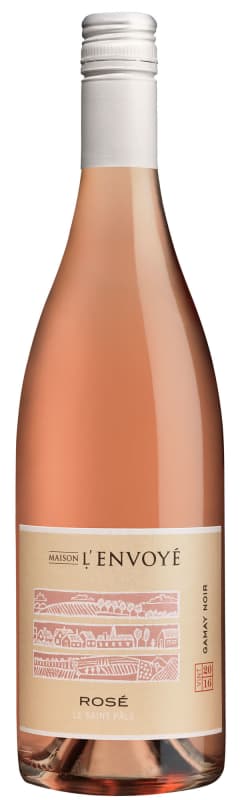


Winemaker Notes
Professional Ratings
-
Wilfred Wong of Wine.com
A rare pink wine from Beaujolais, the 2016 Maison L'Envoye Beaujolais Le Saint Pale Rose shows tart rhubarb in its aroma, medium palate textures, and a crisp finish. Great for a picnic by the seaside. (Tasted: April 27, 2017, San Francisco, CA)

Whether it’s playful and fun or savory and serious, most rosé today is not your grandmother’s White Zinfandel, though that category remains strong. Pink wine has recently become quite trendy, and this time around it’s commonly quite dry. Since the pigment in red wines comes from keeping fermenting juice in contact with the grape skins for an extended period, it follows that a pink wine can be made using just a brief period of skin contact—usually just a couple of days. The resulting color depends on grape variety and winemaking style, ranging from pale salmon to deep magenta.

The bucolic region often identified as the southern part of Burgundy, Beaujolais actually doesn’t have a whole lot in common with the rest of the region in terms of climate, soil types and grape varieties. Beaujolais achieves its own identity with variations on style of one grape, Gamay.
Gamay was actually grown throughout all of Burgundy until 1395 when the Duke of Burgundy banished it south, making room for Pinot Noir to inhabit all of the “superior” hillsides of Burgundy proper. This was good news for Gamay as it produces a much better wine in the granitic soils of Beaujolais, compared with the limestone escarpments of the Côte d’Or.
Four styles of Beaujolais wines exist. The simplest, and one that has regrettably given the region a subpar reputation, is Beaujolais Nouveau. This is the Beaujolais wine that is made using carbonic maceration (a quick fermentation that results in sweet aromas) and is released on the third Thursday of November in the same year as harvest. It's meant to drink young and is flirty, fruity and fun. The rest of Beaujolais is where the serious wines are found. Aside from the wines simply labelled, Beaujolais, there are the Beaujolais-Villages wines, which must come from the hilly northern part of the region, and offer reasonable values with some gems among them. The superior sections are the cru vineyards coming from ten distinct communes: St-Amour, Juliénas, Chénas, Moulin-à-Vent, Fleurie, Chiroubles, Morgon, Regnié, Brouilly, and Côte de Brouilly. Any cru Beajolais will have its commune name prominent on the label.