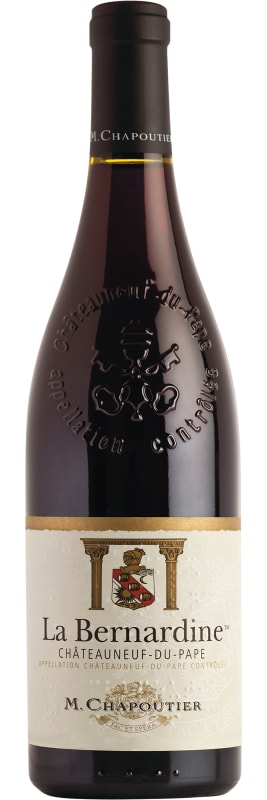


Winemaker Notes
Maison Chapoutier Chateauneuf-du-Pape La Bernardine is an intense crimson-red color. A complex and subtle nose of blackcurrant and plum followed by roasted coffee, cinnamon, and cherry. On the palate, it opens into spice, licorice and fruity notes.
Professional Ratings
-
James Suckling
A succulent, well-balanced and fine-tuned red with notes of red berries, wild herbs, meat and some baking spices as well. It’s medium- to full-bodied with fine, ripe tannins. Well-driven and structured but in control, with an long, intense and flavorful finish.
-
Wine Spectator
Softened plum and wild berry notes share the stage with herbs and savory power. Brown bread, toasted anise and juniper merge in on the harmonious palate, with all of the elements firing in sync. The beautiful texture mostly glossy, with a hint of chewy meatiness and chalk-fine tannins hold a gentle grip as grilled sandalwood smoke closes out. Grenache and Syrah.
-
Robert Parker's Wine Advocate
The 2022 Chateauneuf du Pape la Bernardine, a blend of Grenache Noir, Mourvèdre and Syrah in unknown proportions, offers up aromas of cardamom, garrigue, spices and pepper. Medium to full-bodied, concentrated and generously extracted, with plenty of youthfully chewy tannins, it's framed by a muscular, rather dense palate with a firm, slightly dry finish.
-
Vinous
Spicy and alluring, the 2022 Châteauneuf-du-Pape La Bernardine enters the stage with intense garrigue, licorice and ripe blackberry. Full-bodied, concentrated and framed by edgy tannins, this is an opulent La Bernardine that’s going to need at least two more years to allow the tannins time to resolve. The 2022 checks out with good length on the spicy finish.



No name is more closely associated with the greatness of the Rhone valley than Chapoutier.
The history of the Chapoutier family stretches back to the early nineteenth century when current owner Michel Chapoutier's great-, great-, great-grandfather Marius purchased an estate and some vineyards in the now famous village of Tain l'Hermitage in the Northern Rhône Valley. Marius Chapoutier made history in the region when he became the first grape grower there to vinify his own fruit. Marius had tasted wines other winemakers produced using his fruit and he realized that something was lost in translation, so to speak. He knew that he owned some of the best growing sites in the appellation and he believed — rightly — that the grapes grown in his vineyards could produce long-lived world-class wines. In a move unusual at the time, he decided that he should make the wine himself. Not only did the quality of the wines increase greatly, but this move provided the capital to expand the Chapoutiers’ already legendary estate.
A visionary and pioneer in biodynamic winemaking, his restless energy and unconditional commitment to quality have produced tremendous success, with the most 90+ point ratings of all Rhône producers and 16 "100 point" rated wines.
Sothis Gin is distilled from grapes and plants grown near the vineyards. This family domaine is cultivated using biodynamic practices in which plants play a central role. In their wild state they offer M. Chapoutier a better understanding of the soils. When used in vine treatments they help to nourish plant life and support plant growth. They have selected a few of these plants in order to offer a new perspective of their terroirs, the story of a gin originating from the Tain l’Hermitage vineyards and their floral heritage. They have been honing this recipe for many months under the watchful eye of Sothis, the star and also the ancient Goddess who teaches us that cultivating the land is a means of moving closer to the stars.

With bold fruit flavors and accents of sweet spice, Grenache, Syrah and Mourvèdre form the base of the classic Rhône Red Blend, while Carignan, Cinsault and Counoise often come in to play. Though they originated from France’s southern Rhône Valley, with some creative interpretation, Rhône blends have also become popular in other countries. Somm Secret—Putting their own local spin on the Rhône Red Blend, those from Priorat often include Merlot and Cabernet Sauvignon. In California, it is not uncommon to see Petite Sirah make an appearance.

Famous for its full-bodied, seductive and spicy reds with flavor and aroma characteristics reminiscent of black cherry, baked raspberry, garrigue, olive tapenade, lavender and baking spice, Châteauneuf-du-Pape is the leading sub-appellation of the southern Rhône River Valley. Large pebbles resembling river rocks, called "galets" in French, dominate most of the terrain. The stones hold heat and reflect it back up to the low-lying gobelet-trained vines. Though the galets are typical, they are not prominent in every vineyard. Chateau Rayas is the most obvious deviation with very sandy soil.
According to law, eighteen grape varieties are allowed in Châteauneuf-du-Pape and most wines are blends of some mix of these. For reds, Grenache is the star player with Mourvedre and Syrah coming typically second. Others used include Cinsault, Counoise and occasionally Muscardin, Vaccarèse, Picquepoul Noir and Terret Noir.
Only about 6-7% of wine from Châteauneuf-du-Pape is white wine. Blends and single-varietal bottlings are typically based on the soft and floral Grenache Blanc but Clairette, Bourboulenc and Roussanne are grown with some significance.
The wine of Chateauneuf-du-Pape takes its name from the relocation of the papal court to Avignon. The lore says that after moving in 1309, Pope Clément V (after whom Chateau Pape-Clément in Pessac-Léognan is named) ordered that vines were planted. But it was actually his successor, John XXII, who established the vineyards. The name however, Chateauneuf-du-Pape, translated as "the pope's new castle," didn’t really stick until the 19th century.