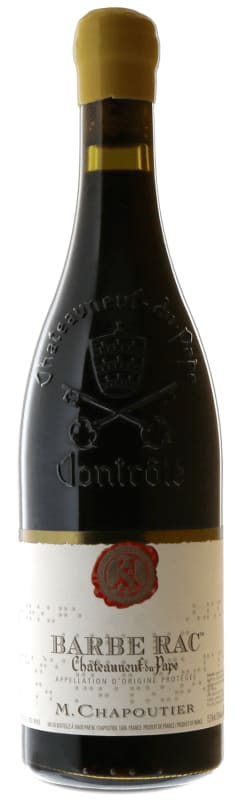


Winemaker Notes
Intense garnet in color. Aromas of herbs, spices, licorice, chocolate, and fruits such as strawberry. Ample, fleshy, hot and round. Outstanding density with an impressive length.
Professional Ratings
-
Jeb Dunnuck
Even better and one of the top 5-8 wines of the vintage, the 100% Grenache 2010 M. Chapoutier Châteauneuf-du-Pape Barbe Rac is more serious, structured, and reserved than the Croix de Bois. Aged all in vat for 16 months, it offers up a profound array of small berry fruit, wild flowers, liquid minerality, white pepper, and garrigue that is followed by an energetic, lively Châteauneuf-du-Pape that has full-bodied power, perfect balance, and an incredible, seamless, and polished texture that carries masses of finely polished tannin. World-class stuff, and while I would drink it any day of the week, it deserves 5-7 years of bottle age, and will age gracefully for two decades or more.
-
Wine Spectator
So lush, so warm, so inviting, with ganache, plum sauce and blackberry coulis notes that fan out beautifully. But there's grip as well, with a mix of tar, shiso leaf, signed iron and charcoal all weaving through the finish, adding muscle and definition. Offers terrific range and length. Almost drinkable now, but this will get better. Best from 2014 through 2035.
-
Robert Parker's Wine Advocate
A magnificent effort, the 2010 Chateauneuf du Pape Barbe Rac boasts huge notes of kirsch, exotic herbs, lavender, cedar, fig, black cherry, black currant, licorice and roasted meats. This flamboyant, rich, full-throttle Chateauneuf du Pape should age well for two decades. It will be interesting to follow this wine’s evolution alongside the brilliant 2009 and 2007 Barbe Racs.
-
Vinous
Saturated ruby. Black and blue fruits, violet and incense on the pungent, intensely perfumed nose. Stains the palate with sappy cassis and blackberry flavors, picking up spice and smoke on the back half. Cola and floral pastille nuances come up with air and carry through a strikingly long, gently tannic finish. More powerful than the Croix du Bois, with greater depth but less finesse, relatively speaking.



No name is more closely associated with the greatness of the Rhone valley than Chapoutier.
The history of the Chapoutier family stretches back to the early nineteenth century when current owner Michel Chapoutier's great-, great-, great-grandfather Marius purchased an estate and some vineyards in the now famous village of Tain l'Hermitage in the Northern Rhône Valley. Marius Chapoutier made history in the region when he became the first grape grower there to vinify his own fruit. Marius had tasted wines other winemakers produced using his fruit and he realized that something was lost in translation, so to speak. He knew that he owned some of the best growing sites in the appellation and he believed — rightly — that the grapes grown in his vineyards could produce long-lived world-class wines. In a move unusual at the time, he decided that he should make the wine himself. Not only did the quality of the wines increase greatly, but this move provided the capital to expand the Chapoutiers’ already legendary estate.
A visionary and pioneer in biodynamic winemaking, his restless energy and unconditional commitment to quality have produced tremendous success, with the most 90+ point ratings of all Rhône producers and 16 "100 point" rated wines.
Sothis Gin is distilled from grapes and plants grown near the vineyards. This family domaine is cultivated using biodynamic practices in which plants play a central role. In their wild state they offer M. Chapoutier a better understanding of the soils. When used in vine treatments they help to nourish plant life and support plant growth. They have selected a few of these plants in order to offer a new perspective of their terroirs, the story of a gin originating from the Tain l’Hermitage vineyards and their floral heritage. They have been honing this recipe for many months under the watchful eye of Sothis, the star and also the ancient Goddess who teaches us that cultivating the land is a means of moving closer to the stars.

Grenache thrives in any warm, Mediterranean climate where ample sunlight allows its clusters to achieve full phenolic ripeness. While Grenache's birthplace is Spain (there called Garnacha), today it is more recognized as the key player in the red blends of the Southern Rhône, namely Châteauneuf-du-Pape, Côtes du Rhône and its villages. Somm Secret—The Italian island of Sardinia produces bold, rustic, single varietal Grenache (there called Cannonau). California, Washington and Australia have achieved found success with Grenache, both flying solo and in blends.

Famous for its full-bodied, seductive and spicy reds with flavor and aroma characteristics reminiscent of black cherry, baked raspberry, garrigue, olive tapenade, lavender and baking spice, Châteauneuf-du-Pape is the leading sub-appellation of the southern Rhône River Valley. Large pebbles resembling river rocks, called "galets" in French, dominate most of the terrain. The stones hold heat and reflect it back up to the low-lying gobelet-trained vines. Though the galets are typical, they are not prominent in every vineyard. Chateau Rayas is the most obvious deviation with very sandy soil.
According to law, eighteen grape varieties are allowed in Châteauneuf-du-Pape and most wines are blends of some mix of these. For reds, Grenache is the star player with Mourvedre and Syrah coming typically second. Others used include Cinsault, Counoise and occasionally Muscardin, Vaccarèse, Picquepoul Noir and Terret Noir.
Only about 6-7% of wine from Châteauneuf-du-Pape is white wine. Blends and single-varietal bottlings are typically based on the soft and floral Grenache Blanc but Clairette, Bourboulenc and Roussanne are grown with some significance.
The wine of Chateauneuf-du-Pape takes its name from the relocation of the papal court to Avignon. The lore says that after moving in 1309, Pope Clément V (after whom Chateau Pape-Clément in Pessac-Léognan is named) ordered that vines were planted. But it was actually his successor, John XXII, who established the vineyards. The name however, Chateauneuf-du-Pape, translated as "the pope's new castle," didn’t really stick until the 19th century.