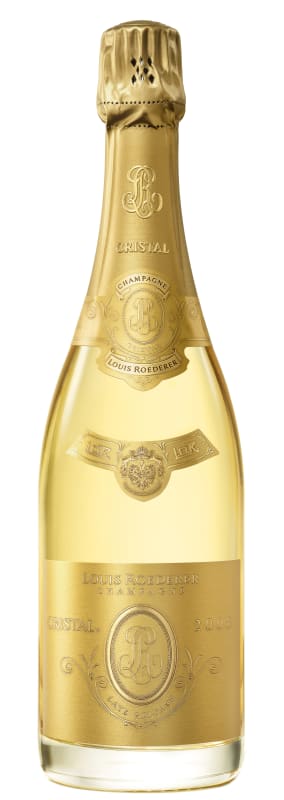


Winemaker Notes
Powdery, chalky bouquet with ripe, fruity notes reminiscent of juicy candied lemon, along with hints of almond, harvested grain and lightly roasted cocoa beans. The aromas are fresh, well-honed and clean-cut. After aeration, one is almost surprised by the emergence of a floral and vegetal freshness intertwined with finely toasted hazelnuts. On the palate, the freshness is incredible… for a17-year-old wine! It has aged beautifully, gaining in thickness and richness, yet the saline substance and the drying freshness from the chalk soils preserve the great finesse of this Cristal 2008… It delivers a tactile sensation - almost like a liqueur rolling over the palate - powerful yet soft. The bubbles, too, have benefited from the long ageing, becoming softer and smoother, melting into the texture and enhancing the salinity to the point of creating “salt bubbles.” The substance, now deeper than in the original disgorgement, creates a more composed, serene and mouthwatering quality, developing hints of white chocolate. The impression is one of great depth and seamless balance. The finish is prolonged by the saline quality, accompanied by some dry, noble bitters, followed by an unexpected retro-nasal impression of Havana cigar, cedar and undergrowth. Cristal Late Release 2008 is impeccable - refined, precise and gossamer-like.
Professional Ratings
-
Vinous
The 2008 Cristal Late-Released is a special cuvée bottled to celebrate Cristal’s 150th Anniversary. It spent an added four years on the lees, which places it between the regular release and the Vinothèque in terms of aging. Explosive in the glass, the 2008 possesses off-the-charts textural richness and density, much of that coming from the shaking of the bottles during élevage (poignettage). That extra mid-palate resonance fills out the layers, resulting in a Cristal that is utterly profound. Unforgettable. Disgorged: 2020.
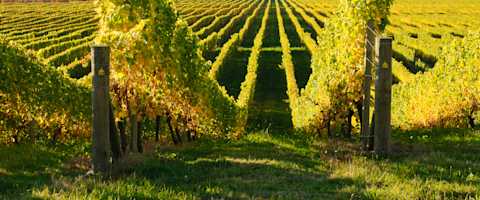




Uncompromising Quality
Champagne Louis Roederer was founded in 1776 in Reims, France and is one of the rare family owned companies, which is still managed by the Roederer family. In 1833, Louis Roederer inherited the company from his uncle and renamed the company under his namesake. Under his leadership, the company rapidly grew while remaining true to their philosophy of uncompromising quality. Today, the company is under the helm of Jean-Claude Rouzaud and his son Frédéric who continue to place quality before quantity.
First-Rate Vineyards
Champagne Louis Roederer is one of the only French champagne producers to own nearly 75 percent of the grapes in the most desirable vineyards in the Champagne. The property is located on 450 acres in the finest villages of Montagne de Reims, Côtes des Blancs, and Valleé de la Marne. Each region is selected to produce Chardonnay and Pinot Noir with the elegance needed for perfectly balanced champagne. The Louis Roederer vineyards rate an average 98 percent based on France’s statutory 100-point classification scale.
The reserve wine is then tasted and graded by a team of Roederer specialists. They choose as many as 40 different wines from several lots for the blend. For the final touch, the wine is then added in order to enhance the cuvee and guarantee consistency while retaining the champagne's characteristics.
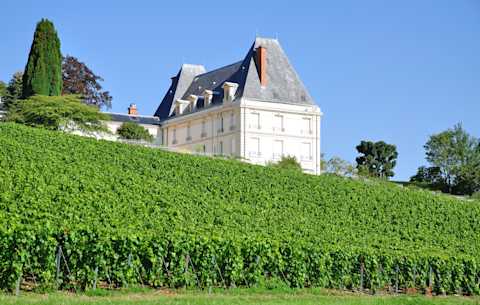
Representing the topmost expression of a Champagne house, a vintage Champagne is one made from the produce of a single, superior harvest year. Vintage Champagnes account for a mere 5% of total Champagne production and are produced about three times in a decade. Champagne is typically made as a blend of multiple years in order to preserve the house style; these will have non-vintage, or simply, NV on the label. The term, "vintage," as it applies to all wine, simply means a single harvest year.

Associated with luxury, celebration, and romance, the region, Champagne, is home to the world’s most prized sparkling wine. In order to bear the label, ‘Champagne’, a sparkling wine must originate from this northeastern region of France—called Champagne—and adhere to strict quality standards. Made up of the three towns Reims, Épernay, and Aÿ, it was here that the traditional method of sparkling wine production was both invented and perfected, birthing a winemaking technique as well as a flavor profile that is now emulated worldwide.
Well-drained, limestone and chalky soil defines much of the region, which lend a mineral component to its wines. Champagne’s cold, continental climate promotes ample acidity in its grapes but weather differences from year to year can create significant variation between vintages. While vintage Champagnes are produced in exceptional years, non-vintage cuvées are produced annually from a blend of several years in order to produce Champagnes that maintain a consistent house style.
With nearly negligible exceptions, . These can be blended together or bottled as individual varietal Champagnes, depending on the final style of wine desired. Chardonnay, the only white variety, contributes freshness, elegance, lively acidity and notes of citrus, orchard fruit and white flowers. Pinot Noir and its relative Pinot Meunier, provide the backbone to many blends, adding structure, body and supple red fruit flavors. Wines with a large proportion of Pinot Meunier will be ready to drink earlier, while Pinot Noir contributes to longevity. Whether it is white or rosé, most Champagne is made from a blend of red and white grapes—and uniquely, rosé is often produce by blending together red and white wine. A Champagne made exclusively from Chardonnay will be labeled as ‘blanc de blancs,’ while ones comprised of only red grapes are called ‘blanc de noirs.’